


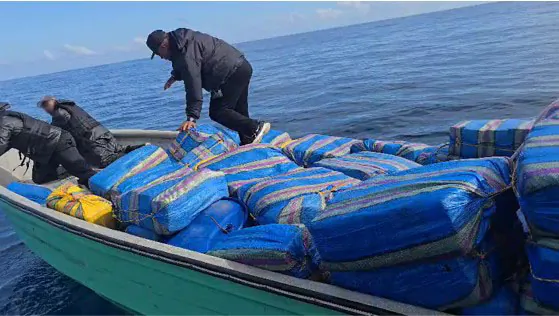
Around 10,000 pounds of marijuana and methamphetamine were seized by U.S. authorities in two separate incidents in recent weeks.
“A joint operation on April 20th led by @ArmadaColombia intercepted a Go-Fast vessel with 3.2 tons of marijuana, the largest load of marijuana ever stopped in Colombian waters, preventing drug-trafficking organizations from reaping the profits,” the Joint Interagency Task Force (JIATF) South said in an April 23 post on X. Armada Colombia is part of the country’s naval defense arm.
The 3.2 tons of marijuana, which comes to 6,400 pounds, has an estimated spot value of roughly $7 million.
In another significant seizure, Customs and Border Protection (CBP) officers at the Otay Mesa Commercial Facility, California, took custody of more than 3,000 pounds of methamphetamine, with an estimated value of $4.92 million, according to an April 23 statement from the agency.
The narcotics were “concealed within a cargo trailer,” which the CBP had referred for a secondary inspection on April 14, the agency said.
“The shipment manifest had listed the commodity as corrugated cardboard boxes,” it said.
An initial nonintrusive inspection identified anomalies in the front wall of the trailer. A physical inspection found 300 packages of meth.
According to a report from the Centers for Disease Control and Prevention, the overdose death rate involving psychostimulants with abuse potential, primarily methamphetamine, was 10.4 people per 100,000 individuals in 2023.
“Our CBP officers at ports of entry are unwavering guardians,” Otay Mesa Port Director Rosa E. Hernandez said.
“Their diligence prevented illegal narcotics from entering our country, so our communities are kept safe from dangerous drugs.”
Tackling the inflow of drugs is a key focus area of the Trump administration. In an April 2025 Statement of Drug Policy Priorities, the White House said the administration has identified an “urgent need for decisive action” to tackle the illicit drug crisis plaguing the United States.
According to the statement, the Trump administration aims to reduce the number of overdose fatalities, decrease the global movement of illicit drugs, stop the flow of drugs from across the border into U.S. communities, reduce the initiation of drug use, and offer treatments that lead to long-term recovery from addiction and substance use disorders.
Crackdown on Drug Operations
In a March 17 statement to a House committee, Joseph M. Humire, performing the duties of the assistant secretary of war for homeland defense and Americas security affairs, said the Department of War (DOW) has been focusing on the maritime flow of illicit narcotics into the United States from South America.Since September 2025, the DOW has been conducting kinetic strikes on suspected drug trafficking vessels that have had a positive impact in curtailing drug flow, according to the official.
“We have successfully deterred cartels from exploiting key maritime routes, leading to a more than 20 percent reduction in cocaine flow.”
Last week, the White House Office of National Drug Control Policy hosted the Interdiction Committee Principals Meeting, with officials from the State Department, Homeland Security, Justice Department, DOW, the Treasury, and the Intelligence Community meeting to advance President Donald Trump’s drug policy priorities, the White House said in an April 20 statement.
Participants discussed matters related to current operations aimed at reducing the supply of illicit drugs, and reviewed methods to integrate information from drug interdictions to investigations in order to better target criminal networks.
“The Interdiction Committee is where policy and operations collide. We know that every interdiction, every arrest, and every successful prosecution is an opportunity for law enforcement and the intelligence community to combat cartel operations, their supply chains, and the illicit financing that fuels it all,” U.S. Interdiction Coordinator and Committee Chairperson Daniel Boatright said.