


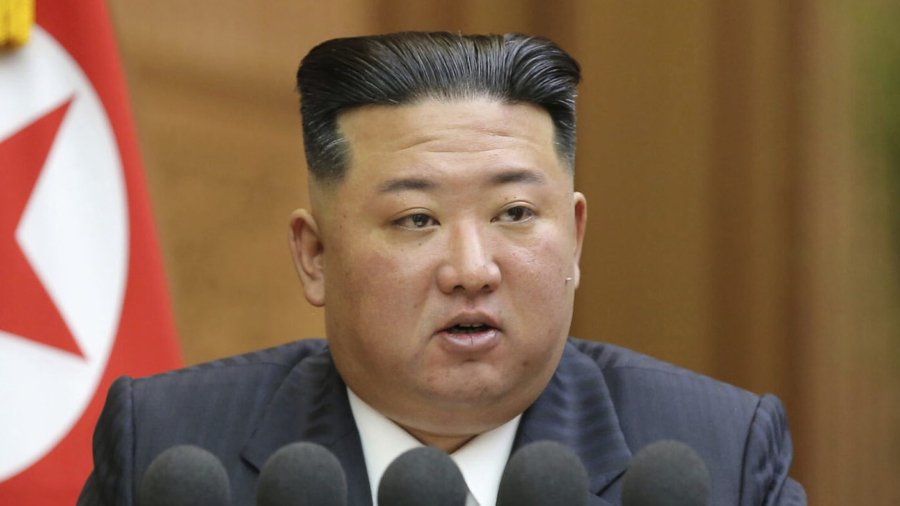
North Korea accused the United States and South Korea of escalating tensions “to the brink of nuclear war” through their recent joint military drills, with the communist dictatorship vowing to respond with “offensive action.”
North Korea’s state news agency, KCNA, published a commentary by Choe Ju Hyon—who the agency referred to as an international security analyst—criticizing the exercises as “a trigger for driving the situation on the Korean peninsula to the point of explosion.
“The reckless military confrontational hysteria of the U.S. and its followers against the DPRK [Democratic People's Republic of Korea] is driving the situation on the Korean peninsula to an irreversible catastrophe ... to the brink of a nuclear war,” the article said.
Regular Drills
United States and South Korean forces hold a series of springtime exercises each year, which typically involve air and sea drills. This year also included the first large-scale amphibious landing drill in five years.
About 12,000 soldiers from the two allied forces took part, as did 30 warships, 50 amphibious assault vehicles, and 70 aircraft—including B-1B and B-52 bombers, as well as 10 F-35 fighters.While Pyongyang has called the exercises a rehearsal for invasion, South Korea and the United States maintain that the drills were purely defensive.
North Korean Nuclear Brinkmanship
Two weeks ago, the KCNA announced that North Korea had successfully tested a new nuclear-capable underwater attack drone.The following week, North Korea fired four ballistic missiles off its east coast in response to the drills.
The day after, the communist dictatorship unveiled newly developed miniaturized nuclear warheads that are claimed to be compatible with at least eight different launching platforms, including submarines and, possibly, intercontinental ballistic missiles capable of reaching the United States.
Kune Y. Suh, professor emeritus of nuclear engineering at Seoul National University, called it a worrisome development. “It’s something more powerful in a smaller package,” he said, comparing the new warheads to their 2016 predecessors.
According to KCNA, Kim Jong Un has claimed that “the enemy of the country’s nuclear forces” was not a specific state or group, but rather “war and nuclear disaster themselves.” The policy of expanding the nuclear arsenal was solely for securing regional peace and stability, the North Korean leader said.
After consulting with U.S. and Japanese nuclear envoys, Seoul's foreign ministry condemned North Korea for its provocations. The ministry also announced that an agreement has been made to increase counter-measures against North Korea’s cyber aggressions, which has included stealing crypto currencies and other forms of hacking.
Japan's foreign ministry said its nuclear envoy “strongly condemned” North Korea's “unprecedented frequency and manner” of missile launches.