The number of plane crashes thus far in 2025 remains consistent with past years, according to data from the National Transportation Safety Board (NTSB). In addition, the organization says the number of fatal commercial plane crashes worldwide has declined overall since 2019. However, several high-profile accidents have made headlines recently, with some families suing airlines over the incidents.
According to the NTSB's Monthly Aviation
Dashboard, there have been 15 fatal plane crashes and 94 non-fatal crashes in 2025, as of Feb. 25. Of the 109 crashes, 63 occurred in January and 46 in February.
Over the last decade, according to available data, fatal aircraft accidents peaked at 379 in 2019, before dropping to their lowest level last year, with 260 recorded. The average over the last ten years lay at around 330 fatal accidents per year.
Despite the overall decline, recent incidents have brought aviation safety into the spotlight. On Jan. 29, a
midair collision between American Airlines Flight 5342 and a U.S. Army Black Hawk helicopter over the Potomac River near Reagan National Airport resulted in 67 deaths.
After the accident, the family of 40-year-old American Airlines passenger Casey Crafton from Salem, Connecticut, filed $250 million
claims against both the Federal Aviation Administration (FAA) and the U.S. Army on Feb. 18. Robert A. Clifford, the family's attorney, stated that, "Casey was an incredible human being. He was a giver. He was a loving husband and father. He enjoyed coaching his boys on their youth soccer and little league baseball teams. They will be grieving him for the rest of their lives that will never be the same."
The claims allege negligence on behalf of federal employees, specifically the FAA for potential air traffic control issues and the U.S. Army for the operation of the military helicopter. The NTSB reported that staffing in the air traffic control tower was "not normal" at the time of the collision, and that there were communication lapses between air traffic control and the aircraft.
In another recent
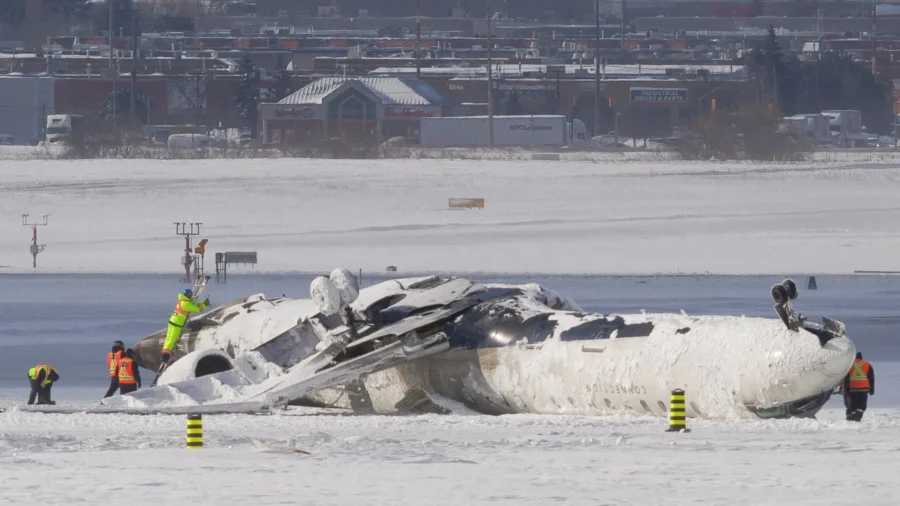
incident, a Delta Air Lines flight operated by subsidiary Endeavor Air crashed during landing at Toronto Pearson International Airport on Feb. 17. The Bombardier CRJ-900 aircraft was carrying 80 passengers and crew members when it flipped upside down after landing. According to a Feb. 19
press release from DJC Law, a legal firm representing one of the passengers on the flight, the incident caused "significant injuries" to a number of passengers, including the firm's client.
Two passengers have filed separate lawsuits against Delta Air Lines and Endeavor Air following the accident. Marthinus Lourens, a U.S. citizen and Texas resident, filed a
lawsuit in the United States District Court for the Northern District of Georgia on Feb. 23. The lawsuit claims that Lourens "was violently tossed about and ended up upside down hanging from his seatbelt inside a burning plane with aviation fuel leaking onto him."
In a separate
lawsuit, Minneapolis resident Hannah Krebs filed against Delta Air Lines and Endeavor Air in the U.S. District Court for the District of Minnesota. The lawsuit alleges that the crash occurred due to "gross negligence and recklessness of the Delta and/or Endeavor flight crew on Flight 4819," which the suit claimed was in violation of several international and U.S. airline industry standards.
The Transportation Safety Board of Canada (TSB) has launched an investigation into the cause of the accident. As of Feb. 19, investigators had removed the cockpit voice recorder and flight data recorder from the wreckage to aid in determining the factors that led to the crash, according to the
TSB.
In response to rumors about the flight crew's qualifications, Delta Air Lines issued a
statement on Feb. 20 to address what it called "disinformation in social media containing false and misleading assertions about the flight crew of Endeavor Air 4819." The airline defended the experience and qualifications of both the captain and first officer involved in the incident.
The aviation world will soon have more flights to navigate than just those of planes and military aircraft. In October, the FAA issued a final rule outlining operational guidelines and pilot training requirements for electric-powered
air taxis. Mike Whitaker, head of the FAA, stated that "powered-lift aircraft" will soon join airplanes and helicopters in the skies on a large scale, and emphasized the agency's commitment to safety.