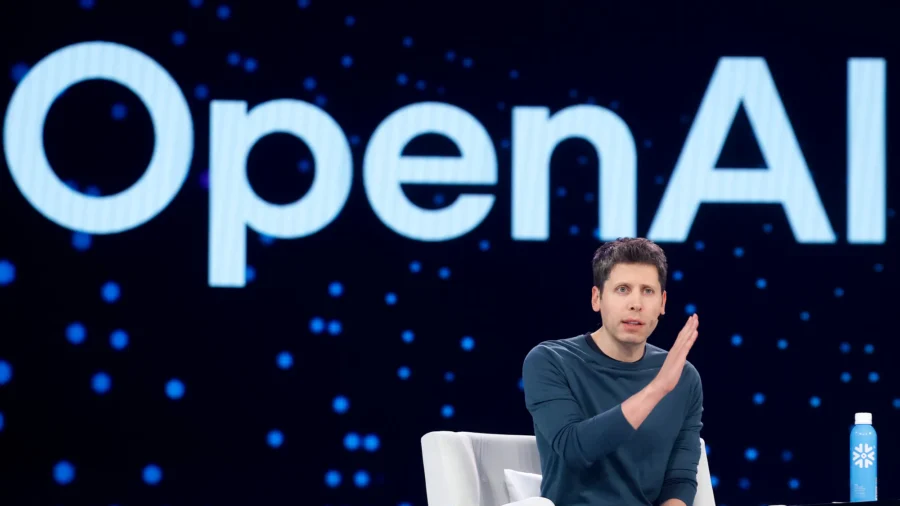
OpenAI has signed a $38 billion agreement with Amazon Web Services (AWS), marking one of the ChatGPT developer's biggest steps to expand beyond Microsoft to meet its surging demand for computing power.
Under the seven-year deal
announced on Nov. 3, OpenAI will immediately begin running its artificial intelligence (AI) workloads on AWS infrastructure, tapping into hundreds of thousands of Nvidia graphics processing units hosted in U.S. data centers.
All of the targeted capacity is expected to be online by the end of 2026, with the option to expand further through 2027 and beyond.
OpenAI announced that it will utilize AWS compute resources for a range of AI operations, including ChatGPT inference and training new models.
"Our partnership with AWS strengthens the broad compute ecosystem that will power this next era and bring advanced AI to everyone," Sam Altman, OpenAI's co-founder and CEO, said in a statement.
Amazon, the world's largest provider of rented computing power, hailed the partnership as a milestone in the AI boom triggered by the introduction of ChatGPT three years ago.
"As OpenAI continues to push the boundaries of what's possible, AWS's best-in-class infrastructure will serve as a backbone for their AI ambitions," AWS CEO Matt Garman said in a statement.
OpenAI has been on a dealmaking spree in recent months, announcing infrastructure buildout agreements with
Nvidia,
Broadcom,
Oracle, and
Google.
The company,
according to Altman, has committed to spending about $1.4 trillion on infrastructure, equivalent to roughly 30 gigawatts of data center capacity.
Until recently, OpenAI had an exclusive cloud agreement with Microsoft, which first backed the company in 2019 and has invested a total of $13 billion in it.
In January, Microsoft
announced that it would no longer be OpenAI's exclusive cloud provider, instead moving to a new arrangement where it would have a "right of first refusal" for future infrastructure requests.
However, under newly renegotiated
terms, Microsoft gave up its right of first refusal in exchange for a 27 percent stake in OpenAI's for-profit business, valued at $135 billion. Additionally, OpenAI agreed to purchase an additional $250 billion in Microsoft Azure cloud services over an undisclosed period.
The new structure frees OpenAI to partner more broadly with other providers of large-scale data centers and highly scalable cloud services, including AWS, the dominant player in that market.
The unprecedented wave of AI infrastructure spending has sparked concerns about a potential investment bubble reminiscent of the late 1990s dot-com era. While optimists view the trillion-dollar buildout as the foundation for a new productivity revolution, critics
warn that the industry may be creating more capacity than actual demand, with capital flooding into anything labeled "AI" solely because of market hype rather than proven utility.
When asked whether the current AI surge resembles the dot-com bubble, Federal Reserve Chair Jerome Powell
noted a key distinction: companies driving the AI wave today are profitable.
"This is different in the sense that these companies, the companies that are so highly valued, actually have earnings and stuff like that," Powell told reporters after the Fed's policy meeting on Oct. 30.
"The investment we're getting in equipment and all those things go into creating data centers and feeding the AI, it's clearly one of the big sources of growth in the economy."
The comment came as Microsoft
reported $27 billion in quarterly profit, with a significant share directed toward expanding its AI data centers. Amazon, meanwhile, also
posted a 13 percent increase in net sales to $180 billion in the third quarter, driven by a 20 percent jump in AWS revenue.