


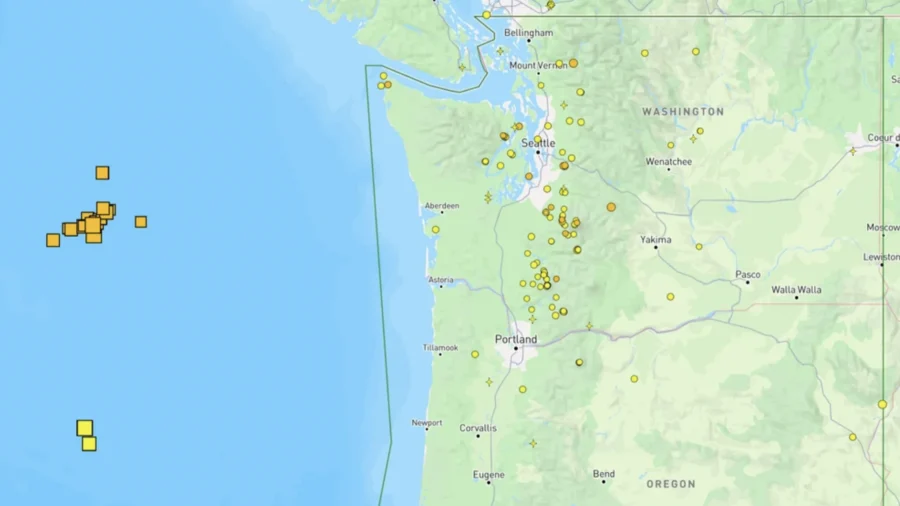
A swarm of small to moderate earthquakes rattled the seafloor off the Washington coast early Sunday. Regional seismologists said there is no threat to coastal communities.
The Pacific Northwest Seismic Network reported 18 plus earthquakes near the Juan de Fuca Ridge beginning around midnight Pacific Daylight Time on April 12. The strongest earthquake registered a magnitude 4.2. The swarm was located about 250 miles offshore, far from the Cascadia Subduction Zone, a major fault that is capable of producing large earthquakes and tsunamis.
The largest was about 254 miles west of Aberdeen at 4:48 a.m. Sunday. One person reported feeling shaking as far inland as Stevenson, according to USGS data.
The offshore area sits along the Juan de Fuca Ridge, a seafloor spreading center where tectonic plates pull apart and new crust forms. The ridge runs parallel to the Pacific Northwest coast and feeds a network of fracture zones, including the Blanco Fracture Zone, which is one of the most active fault areas in the region.
No tsunami warnings were issued, and there were no immediate reports of damage or injuries.
The region faces significant seismic risk from the Cascadia Subduction Zone, a major offshore fault where the Juan de Fuca Plate slips beneath the North American Plate.
“Currently, scientists are predicting that there is about a 37% chance that a megathrust earthquake of 7.1+ magnitude in this fault zone will occur in the next 50 years. This event will be felt throughout the Pacific Northwest,” according to the OEM.