


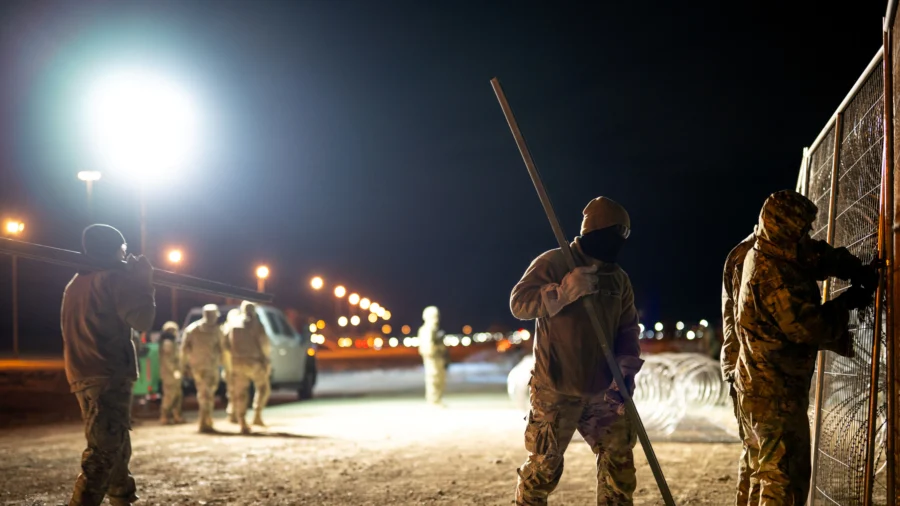
The Department of Defense is establishing a new military buffer zone—known as a national defense area—along the southwestern border to curb illegal immigration.
The land was previously managed by the International Boundary and Water Commission, an agency overseeing water-sharing between the United States and Mexico.
While the U.S. military generally does not perform civilian law enforcement, the national defense area designation grants limited legal authority for specific actions. Within these zones, servicemembers may help with setting up barriers and signs, conduct patrols—much like on any military base—and temporarily detain trespassers until they are transferred to the appropriate law enforcement authorities.
The first national defense area was designated in April, a 170-mile zone in New Mexico, attached to Fort Huachuca in neighboring Arizona. The following month, a 63-mile section was set up in West Texas under Fort Bliss.
Combined with the new Texas stretch, the total area under national defense area designation now exceeds 480 miles. The Texas–Mexico border extends 1,254 miles.
The Epoch Times has reached out to the Departments of Defense and the U.S. Navy for confirmation regarding any other national defense areas in the works.
In his ruling, U.S. magistrate judge Gregory Wormuth said the federal government had failed to prove that the accused individuals knew they were entering a restricted military zone, despite posted signs in both English and Spanish warning that unauthorized entry was prohibited.
“As the United States concedes, the NMNDA [New Mexico National Defense Area] spans over 180 miles of ‘often difficult and mountainous terrain,'” the judge said. “The mere fact that some ‘signs’ were posted in the NMNDA provides no basis on which to conclude that the defendant could have seen, let alone did see, the signs.”
The judge’s decision dismissed two misdemeanor charges faced by the 98 migrants arrested: violating a security regulation and entering military property for an unlawful purpose. A third misdemeanor charge of illegal border crossing still stands.