


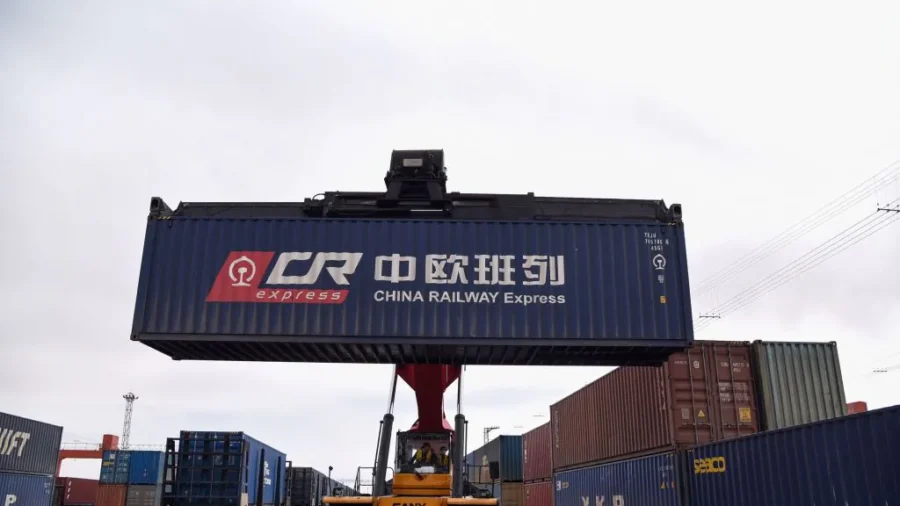
Poland's indefinite border closure with Belarus has abruptly disrupted the Chinese regime, slashing 90 percent of the quickest-expanding trade routes linking China to Europe.
Poland enacted this measure on Sept. 11 to monitor Russia and Belarus's quadrennial Zapad 2025 military exercises, which featured a mock nuclear attack. But the measure has shifted from what was initially a short-term safeguard into an indefinite one. Officials now say that "traffic will be restored once the border is fully safe.”
Businesses Stuck
Sun, an automotive parts supplier from Shandong province, told the Chinese edition of The Epoch Times that the suspension of the China-Europe Railway has driven up the company's operating costs."Rail transport is twice as fast as sea freight—it takes 15 to 20 days to reach the destination, while sea shipping requires 1 to 1.5 months. Our warehouse has been packed full, and we're shelling out extra money every day just on storage and interest. We're forced to switch to sea transport, but our clients are pressing us hard." He said.
"If delays exceed two weeks, it could disrupt client production, putting us at risk of breaching contracts," he added.
Li, a cross-border e-commerce operator from Yiwu city, Zhejiang province, said: "We had a batch of fall clothing slated for delivery to a German warehouse in three weeks; now it's likely delayed by more than three weeks. Switching to air freight would triple the costs compared to rail—we simply can't absorb that loss."
An exporter of tablet computers from Shenzhen city said: "Rail transport was our go-to for balancing speed and cost; now we're stuck stockpiling extra inventory, which has ramped up our cash flow pressure significantly."
EU-China Strained Relations
Poland’s government said the decision was driven by security imperatives rather than economics. “The logic of trade” was being replaced by “the logic of security,” it said.The European Commission has backed Warsaw's position, describing it as a legitimate reaction to Russia's "illegal and unjustified war."
To ease tensions, Chinese Foreign Minister Wang Yi made a visit to Poland on Sept. 15, holding separate meetings with the Polish president and foreign minister.
China offered enhanced cargo inspections and added security measures, hoping to get Poland to resume rail services, but talks yielded no breakthroughs as Warsaw maintained the border closure. While Beijing touted renewed pledges for "sustainable" bilateral trade, its official readout skipped mention of the shutdown.
A Beijing-based scholar, who preferred not to use his name, told The Epoch Times: "Wang Yi's trip shows how seriously China takes the China-Europe freight trains, but political and security concerns now outweigh economic ones."
“Poland has long been dissatisfied with China's support for Russia; this time, it's using the pretext of preventing further Russian actions to block the railway. China can protest all it wants, but it won't help,” he said.
Mr. Zhao, a former researcher at the Chinese Academy of Social Sciences' European Institute, echoed that sentiment, but said that the Russia-Ukraine conflict has escalated with the CCP’s pro-Russia stance, directly threatening European security.
In early September, Russian drones briefly entered Polish airspace, sparking a strong backlash. “Poland's border closure isn't just about disrupting logistics—it's a direct reflection of geopolitics on trade cooperation. In the coming days, if other Baltic states follow suit, which would be very unfavorable for China," he said.
Li, an international relations scholar at Tsinghua University in Beijing, believes that China-Europe relations may gradually slide into a pattern of long-term competition.
"Poland's rail closure makes it clear: the China-Europe freight trains are no longer a stable, reliable option for exporters. Their uncertainty reflects the constraints geopolitics imposes on trade and economic cooperation," he said.
“I believe they are pleased that instead of tariffs, the main land gateway for Chinese goods is now blocked for a while,” he added. “I’m also quite sure the Americans are smiling and supporting the Polish government in not rushing to reopen it — at least not very soon.”