


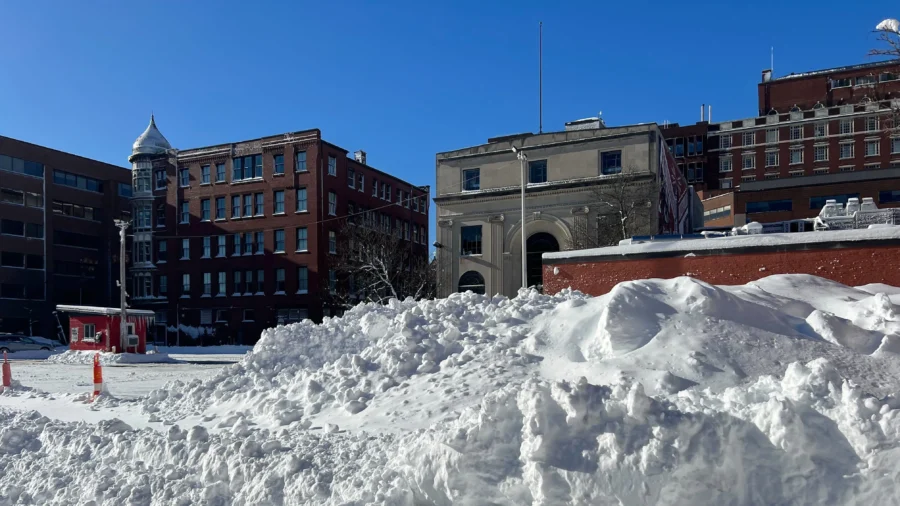
A powerful storm will bring blizzard conditions to the Great Lakes while record heat spreads across the Southwest, creating one of the year’s most extreme coast-to-coast weather contrasts. Flooding rains and strong winds are also expected to impact several regions of the U.S. in the coming days.
These dramatic shifts will occur just days before astronomical spring begins on March 20.
A strong high-pressure system, known as a heat dome, is expected to build over the Southwest early next week, sending temperatures into the triple digits in parts of Arizona and California much earlier than usual.
Phoenix could reach or exceed 100 degrees well ahead of typical seasonal averages, forecasts show. Meteorologists say the massive upper-level ridge fueling the heat may persist through much of the week, sending temperatures higher each day.
Daily temperature records are likely to fall across the Desert Southwest, and some places may approach or break March monthly records. Highs in the 90s are expected early in the week, with the first 100-degree readings of the year possible by Wednesday or Thursday.
The National Oceanic and Atmospheric Administration’s Climate Prediction Center reports a growing risk of above-normal temperatures across much of the western U.S. in its latest hazards outlook.
The heat could expand east later in the week, reaching parts of the Intermountain West and western High Plains. Forecasters say temperatures could hit the 90s in western Texas and western Kansas.
At the same time, the polar vortex—a system of extremely cold air usually confined to the Arctic—is forecast to shift south into the Midwest and East. Forecasters say temperatures could fall to the single digits in some northern cities as the cold air mass spreads across the region.
Two storm systems tracking along the northern tier could bring heavy snow and blizzard conditions from the northern Plains to the Great Lakes.
A powerful mid-latitude cyclone is forecast to move through the Great Lakes on Monday and intensify as it pushes into southeastern Canada by Tuesday. Blizzard conditions are expected in northern Michigan and eastern Wisconsin.
Snowfall totals of 1 to 2 feet are likely in parts of the region, with up to 30 inches possible where persistent snow bands develop. Wind gusts could top 50 mph around the Great Lakes and Northeast, creating whiteout conditions and dangerous travel.
Ahead of the storm’s cold front, heavy rain and strong winds are expected along parts of the East Coast on Monday. Forecasters say 1 to 2 inches of rain is likely in some areas, and embedded thunderstorms could cause localized flooding.
After the storm passes, temperatures will plunge across the eastern U.S., bringing conditions more typical of January than mid-March by Tuesday.
Farther south, a stationary front lingering near Florida could keep showers and thunderstorms active across parts of the southern Florida Peninsula for much of the week.
Meanwhile, in the Northern Plains and Upper Midwest, including North Dakota, South Dakota, and Minnesota, a light wintry mix could be seen as warmer air moves north ahead of a warm front.
The southern part of the storm system may also bring severe thunderstorms and damaging winds to parts of the Midwest and Mississippi Valley, according to the National Weather Service.
Since early this week, severe thunderstorms and damaging winds have affected the Lower Mississippi Valley, Deep South, and parts of the Midwest.
The Storm Prediction Center also warned of tornado potential and strong wind gusts in these areas. The threat was expected to continue through midweek and extend into late week.
Elsewhere, the Pacific Northwest could get periods of heavy rain as an atmospheric river shifts south toward Washington. The Olympic Peninsula faces a risk of excessive rainfall and localized flooding.
Hawaii is also facing heavy rain and flash flood risks as an atmospheric river brings persistent moisture to the islands, forecasters said.