


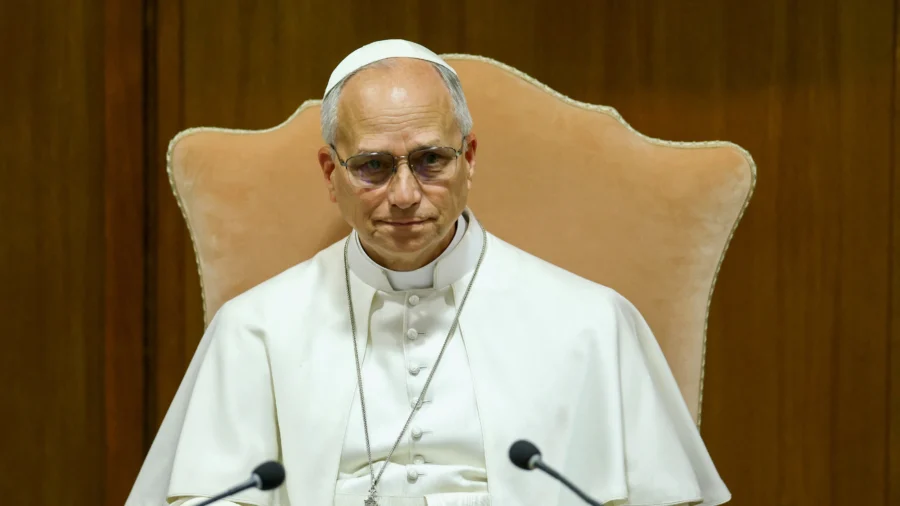
Pope Leo XIV published a document on May 25 that calls for robust regulation and independent oversight of artificial intelligence (AI) and for AI developers not to lose sight of the common good in their quest for profit and technological dominance.
"Magnifica Humanitas" ("Magnificent Humanity") is the U.S.-born pope's first encyclical and is the Vatican's first entry into the AI debate.
"Calling for prudence, rigorous evaluation and even, at times, a slower pace in adopting AI does not mean opposing progress," Leo said in the encyclical. "Instead, it is an exercise of responsible care for the human family.
Need for 'Independent Oversight'
He said abstract ethics on AI were insufficient and that there needed to be "robust legal frameworks, independent oversight, informed users and a political system that does not abdicate its responsibility are required."The text could be another flashpoint between the Vatican and the Trump administration, which is keen on deregulating the development of AI to enable the United States to compete with China and other rivals.
“A carefully crafted national framework can ensure that the United States wins the AI race, as we must,” Trump’s order states.
The new encyclical was signed by Leo on May 15, the 135th anniversary of the publication of "Rerum Novarum" ("Of New Things"), a document published by Pope Leo XIII to address workers’ rights during the Industrial Revolution.
"Today, the convergence of automation, robotics and AI is rapidly transforming the very structure of work," Leo said in the encyclical, adding that while AI promises to boost productivity by taking over mundane tasks, there was a danger of de-skilling workers and relegating them to "rigid and repetitive tasks."
"The need to keep up with the pace of technology can erode workers’ sense of agency and stifle the innovative abilities they are expected to bring to their work. Precisely in order to avoid this drift, it is necessary to design systems that are centered on the human person and not solely on performance.
"The pursuit of greater profits cannot justify choices that systematically sacrifice jobs, because the human person is an end, not a means, and the economic order must remain subordinate to human dignity and the common good.
Threat of 'Anti-Human Vision'
"The risk extends beyond the misuse of certain technologies," Leo said. "More gravely, the pervasive technocratic paradigm in which we are immersed, and that is amplified by the digital revolution and AI, threatens to normalize an anti-human vision."The text was published on the Vatican's website on Monday morning and presented at a livestreamed news conference, where Leo was joined by Anthropic co-founder Christopher Olah.
"If this technology is coming, it must go well for our common home and for the children to come," Olah said.
"Some might believe that matters of AI are best handled by computer scientists like myself. They are mistaken. The questions raised by AI are bigger than the AI research community, not just in their implications, but also in their nature.

"AI systems are not engineered the way a bridge or an airplane is engineered. We understand an airplane because we designed every part of it, and we understand the physics that act on it.
"AI models are not like that. They are grown on a structure roughly modeled after the brain on an enormous inheritance of human thought and speech, and what is grown is far more subtle, odd, and beautiful than science fiction prepared us for."
Pope's Slavery Apology
Earlier on Monday, Leo issued the first papal apology for the Holy See’s historical support for slavery.“It is impossible not to feel deep sorrow when contemplating the immense suffering and humiliation endured by so many in stark contrast to their immeasurable dignity as persons infinitely loved by the Lord,” Leo wrote. “For this, in the name of the Church, I sincerely ask for pardon.”
Among several edicts by the Vatican that condoned slavery, in 1452, Pope Nicholas V issued a papal bull that gave the Portuguese king and his successors the right “to invade, conquer, fight and subjugate” land inhabited by Muslims and pagans and to “reduce their persons to perpetual slavery.”
Leo drew criticism from Trump after comments he made regarding the Iran war and the administration’s immigration policies.
The Epoch Times reached out to the U.S. State Department for comment on "Magnifica Humanitas" but did not receive a response by publication time.