

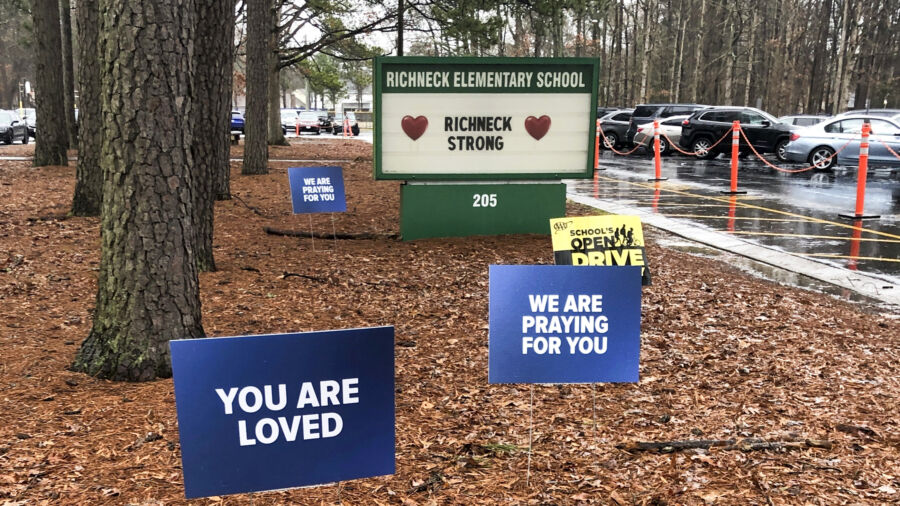
Prosecutors alleged that an elementary school assistant principal did nothing to prevent a 2023 shooting at the Virginia school where she worked.
Ebony Parker was the assistant principal at Richneck Elementary School in Newport News. On Jan. 6, 2023, multiple teachers at the school noticed that a first-grade student, "J.T.," was acting out and potentially had a gun; the student later shot his teacher with it and had to be restrained by another teacher.
At her criminal trial this week, Deputy Commonwealth's Attorney Josh Jenkins said that Parker ignored several teachers who came to her directly before the shooting.
"[A]t 11:45 a.m., Miss Zwerner walks in, tells Dr. Parker that J.T. is in a violent mood, and Dr. Parker does not respond to her, stares at her blankly for just a moment, and then returns to her work in her office, the warning ignored," Jenkins said.
He pointed out that the student had a long history of discipline issues, of which Parker was aware; he later added that one of the witnesses to give testimony for the commonwealth was the student's kindergarten teacher, who had experienced the student's violent behavior firsthand and had met with similar indifference from Parker.
Jenkins said that less than an hour after Zwerner's visit, a reading specialist at the school, Amy Kovac, told Parker she believed J.T. had a gun, but couldn't be sure. Kovac searched the child's backpack but found nothing, because at that point, the student had already taken it out, put it under his coat, and was carrying it on the playground, and even showed it to another student. Kovac informed Parker of this, but Parker said to do nothing, because his mother was arriving shortly. Jenkins said that at 1 p.m., a counselor asked for permission to search the child's person for the gun, but she turned the counselor down for the same reason.
"Multiple warnings brought directly to her," Jenkins said. "She says, 'do nothing.' Does she say, 'search the child?' No. Does she say, 'call the police' or does she call the police? No. Does she remove the child from the classroom and separate? No. She didn't even get up from her desk. She didn't even leave her office. Warning after warning after warning, she did nothing. The crisis in this case did not begin with the firing of a gun."
Jenkins said that just after the shooting, Parker was already locked in her office. Zwerner came into the office, he said, bleeding from a wound in her chest, and collapsed on the floor. Only then did a school receptionist put the school in lockdown. The other 19 students in the room with Zwerner fled to another classroom.
He said that Kovac—who was aware of the child's violent history—heard the shot and went to the classroom, where she saw the gun lying on the floor. She put J.T. in a bear hug while calling 911 and restrained him until police arrived. All the while, the student was screaming that he shot his teacher and cursing.
Jenkins further laid out that Richneck had adopted an emergency management plan in which faculty were required to report situations to administrators, but only the administrators or a school security officer were allowed to take action; Richneck's security officer was at another school with whom he split time. So the only two people with authority to act were Parker and the school principal. But the principal was completely unaware of the situation until she heard the gunshot, because Parker had not informed her.
The teachers wished they had violated the policy, and would say so on the witness stand, said Jenkins. He said Parker likely felt similar regret. But Parker had the authority, and indeed the responsibility to act, and failed.
"I need you to always consider, based upon their actions, there was no crisis, there was no gun," said Rogers.
Parker faces eight counts of child abuse with reckless disregard for life, one for each of the bullets in the magazine of the gun the child used. Each count carries a prison term of up to five years.