


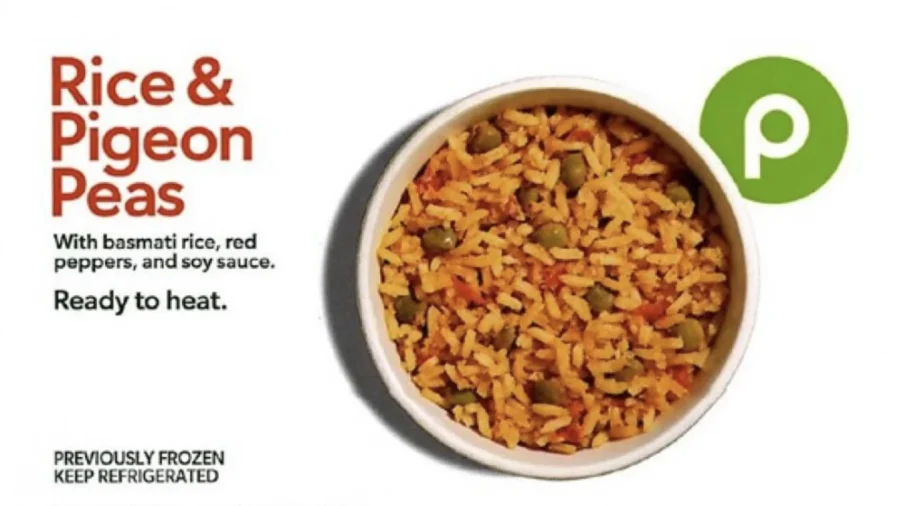
Publix is pulling back a ready-to-eat rice dish sold in Florida after discovering it contains soy that is not listed on the label, a serious risk for people with food allergies.
A.S.K. Foods, LLC of Palmyra, Pa., is recalling select 32-ounce containers of Publix Rice & Pigeon Peas because the product contains undeclared soy, the company said in an announcement released through the U.S. Food and Drug Administration on Dec. 18.
People with a soy allergy or severe soy sensitivity could face a serious or even life-threatening reaction if they eat the dish, the company said.
The product was sold only at Publix stores in Florida. It comes in a plastic tray with a top label reading "Publix Rice & Pigeon Peas, Net Wt. 32 OZ (2 LB) 907," while the bottom label lists "CAVATAPPI PASTA" as the first ingredient and shows a lid code of "5387-4," "5387-5" or "5387-6.”
The trays were mistakenly packaged with an ingredient list meant for Publix Three Cheese Mac & Cheese, which does not declare soy, even though soy is present in the Rice & Pigeon Peas. No illnesses have been reported so far.
Customers who bought the affected item can return it to Publix for a full refund. Shoppers with questions can contact A.S.K. Foods at (717) 838-6356, extension 132, any day of the week from 8 a.m. to 5 p.m. ET.
The recall covers products bearing the Raspberry Coffee Cake label, which notes that the item was processed on equipment that also handles almonds, pecans, and walnuts, but does not list walnuts in the ingredient panel.
The cakes with the wrong label can be spotted because "observable through the clear lid, the product has visible walnuts on top of the cake and brown maple topping, whereas Raspberry Coffee Cake has no walnuts on top and red topping," according to the FDA alert.
The mislabeled cakes were distributed to Publix stores in Alabama, Florida, Georgia, Kentucky, North Carolina, South Carolina, Tennessee, and Virginia.
Earlier in the week, Ukrop's Homestyle Foods of Richmond, Virginia, also pulled back four decorated pound cakes sold at 28 Kroger stores in Virginia and West Virginia and at Ukrop's Market Hall locations in Richmond because of undeclared soy, the FDA announced on Dec. 15.
The FDA recognizes nine major food allergens that must be clearly identified on labels: milk, eggs, fish, shellfish, tree nuts, peanuts, wheat, soybeans, and sesame. Tree nuts include almonds, Brazil nuts, cashews, filberts, hazelnuts, macadamia nuts, pecans, pine nuts, pistachios, and walnuts, and people with nut allergies can face life-threatening reactions such as anaphylaxis if they consume them.
Soy allergies are more common in infants and young children, though they can appear at any age and sometimes develop in people who previously ate soy without problems. About 0.4 percent of infants in the United States are allergic to soy.
Symptoms linked to soy allergy can include stomach pain, nausea, vomiting, diarrhea, indigestion, hives, itching, eczema, cough, throat tightness, and in severe cases, anaphylaxis with dizziness and confusion.
There is no cure for a soy allergy, and strict avoidance of soy is the only sure way to prevent reactions.