


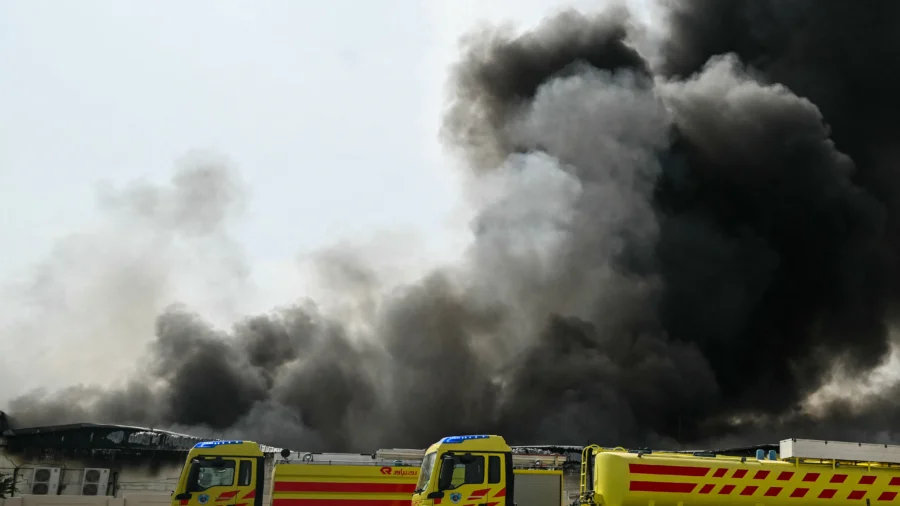
QatarEnergy said it halted LNG production after military attacks on key facilities, sending European gas prices rising by as much as 45 percent.
"Due to military attacks on QatarEnergy’s operating facilities in Ras Laffan Industrial City and Mesaieed Industrial City in the State of Qatar, QatarEnergy has ceased production of liquefied natural gas (LNG) and associated products,” the company said in a March 2 post on X.
QatarEnergy is Qatar’s state-owned energy company and the world’s largest single LNG producer. If the halt applies across its 14 LNG trains, the shutdown could affect close to 20 percent of global LNG supply.
The company gave no further details on the extent or duration of the disruption.
Qatar’s Ministry of Defense said in a post on X on March 2 that the country was hit by two drone attacks launched from Iran, with one drone targeting a water tank at the Mesaieed power plant and the other striking a power plant in Ras Laffan Industrial City.
The ministry said all damages and losses resulting from the attack will be assessed by the relevant authorities, and an official statement will be issued later.
"The Ministry also urges citizens, residents, and visitors to remain calm, adhere to official instructions issued by the security authorities, avoid rumors, and rely solely on information released through official channels," it said.
The benchmark European gas price, traded on the Dutch TTF hub, increased 45 percent to around 46 euros (about $53) per megawatt-hour in early afternoon trading.
Political scientist Velina Tchakarova said in a March 2 post on X that the news "transforms the war’s economic footprint from a threat to European energy security into an active shock."
"However, analysts noted that given an oversupply of LNG in Europe, prices are unlikely to reach the extreme highs of 2022, when Russia’s invasion of Ukraine triggered the last major energy crisis," she said
A wave of attacks on energy infrastructure rattled markets on Monday.
An oil refinery at Ras Tanura, one of Saudi Arabia’s most critical energy hubs, sustained limited damage after debris fell near the site following the interception of two drones, the Saudi Press Agency said in a March 2 post on X.
A small fire was quickly brought under control, no casualties were reported, and some operating units were shut as a precaution, though supplies of petroleum products to the local market were not affected, it said.
While European gas and Asian LNG prices could see relatively more aggressive moves, China is particularly exposed to disruptions to oil exports through the Strait of Hormuz.
Warren Patterson, head of commodities strategy at the bank ING, said on March 1 that in terms of potential impact, there “have already been unconfirmed reports of strikes on Iran’s Kharg Island, where basically all of Iran’s oil is exported from."
“This would be in the region of 1.5m b/d of oil, which goes predominantly to China,” he said.