


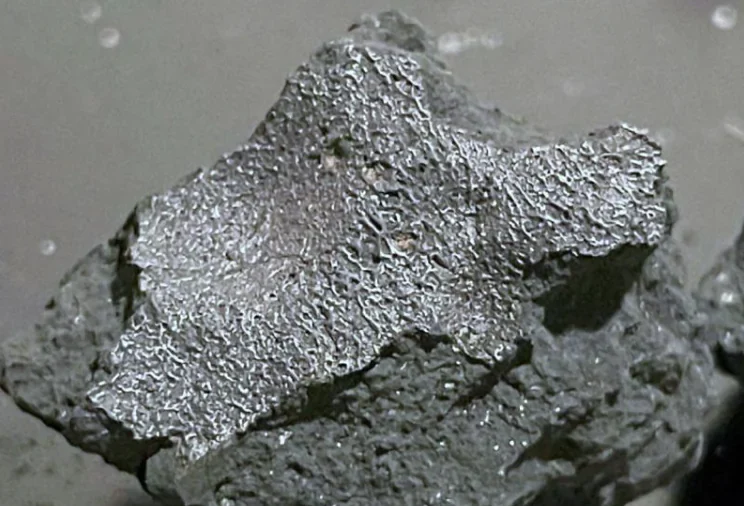
Researchers found evidence that highly concentrated salty liquids, known as brines, once flowed through part of the asteroid before it broke apart in space.
The discovery marks the first time scientists have identified this type of brine activity in a rare CM1/2 carbonaceous chondrite, offering new insight into how water shaped the chemistry of primitive asteroids early in the solar system's history.
Scientists say brines can drive chemical reactions that create increasingly complex organic molecules, making them important to understanding the early solar system.
The meteorite was named Hillsborough after the city where it crashed into a master bedroom in Hillsborough, New Jersey.
It also contained a wide variety of carbon-based compounds, including amino acids. Amino acids are molecules that living things use to build proteins.
The Hillsborough meteorite is considered exceptionally valuable because it was recovered almost immediately after impact, allowing fragile minerals and organic compounds to remain largely uncontaminated by Earth's environment. That pristine condition enabled scientists to study delicate materials that often degrade quickly after meteorites land.
The meteorite fell on July 16, 2024, after a daytime fireball streaked across the skies above the New York City area.
Witnesses across several northeastern states reported seeing the meteor, and some people in New York and New Jersey felt a sonic boom as the space rock entered Earth's atmosphere at about 32,000 mph before breaking apart.
One fragment weighing more than two pounds crashed through the Hillsborough home roof, leaving a hole in the ceiling of a bedroom. The homeowner reported hearing a loud crash, smelling a sulfur-like odor, and finding black rock fragments and dust scattered across the room.
He then used protective gloves, aluminum foil, and glass jars to preserve and protect the meteorite.
Lead author Peter Jenniskens, a meteor astronomer with the SETI Institute and NASA's Ames Research Center, described where the preserved fragments came from on the asteroid.
Carbonaceous chondrites are among the oldest and least altered rocks in the solar system, preserving material formed more than 4.5 billion years ago.
Researchers said some Hillsborough fragments will become part of the permanent collection at the American Museum of Natural History in New York.