


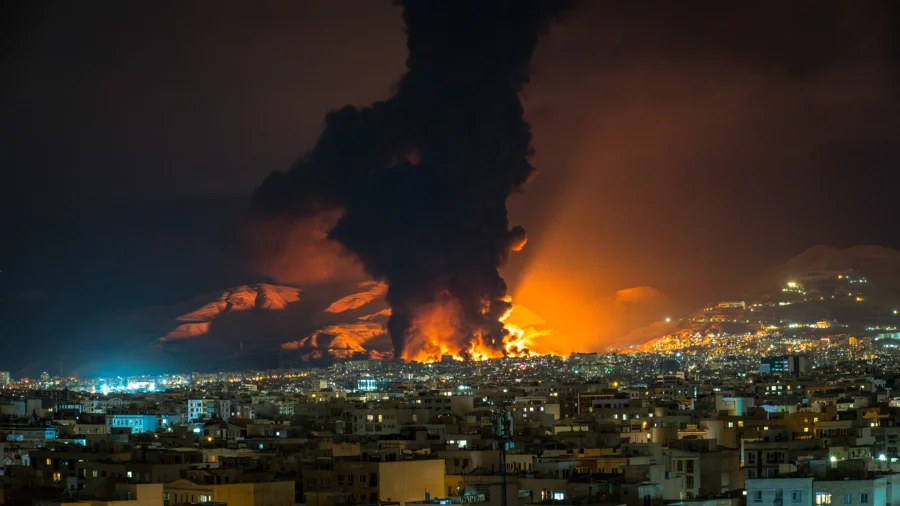
As the conflict involving Iran, the United States, and Israel continues, only a trickle of information is emerging from inside Iran due to the regime cutting off the internet and restrictions on phone communication.
The reports that have surfaced so far, however, point to increased pressure by Islamic Republic authorities on civilians, political prisoners, and anyone suspected of dissent.
This comes as messages received from civilians close to Tehran neighborhoods hit by strikes say the loud sounds of the blasts and resulting waves create a horrifying experience, with prospects of further regime restrictions adding to the concerns.
Messages received from residents across several Iranian cities describe a heavy security presence and warnings from officials against any form of protest or criticism. Judicial and political figures have publicly warned that expressions of dissent could be treated as collaboration with foreign enemies.
The head of Iran’s judiciary, Gholamhossein Mohseni Ejei, on March 4 framed protests as part of what he described as foreign-backed hostility and warned that individuals accused of destabilizing the country or supporting adversaries would face strict punishment.
Other officials have used even stronger language, suggesting that those seen as echoing the positions of foreign enemies could be treated as wartime threats.
In a separate appearance on state television on March 5, Salar Velayatmadar, a commander in the Islamic Revolutionary Guard Corps (IRGC), told parents that if their children support the United States or Israel, “we will deliver a final shot to them.” During the recent anti-regime uprisings in December and January, many young people were among those killed by the regime.
Police authorities have also announced increased enforcement measures. The Islamic Republic’s national police chief said on March 5 that security forces have been authorized to use deadly force against certain crimes during what officials describe as a wartime security situation.
The human rights group Dadban says that wartime conditions have worsened an already fragile environment for prisoners in Iran, particularly political detainees.
Reports from Tehran’s notorious Evin prison, which holds a large number of political prisoners, suggest that administrative order inside the facility has deteriorated.
According to messages from inmates’ families, some prison staff have reportedly left their posts, while detainees remain confined with limited access to food, water, and medical services. Political prisoners have reportedly been denied bail despite the volatile security situation.
Shailin Asadollahi, the sister of Ali Asadollahi, a political prisoner in Evin Prison, said in an Instagram video that he had been expected to be released on bail. However, after the attacks began, prisoners were suddenly transferred to an undisclosed ward.
Beyond prisons and security deployments, the climate of intimidation has also affected Iranian citizens abroad.
Five members of Iran’s women’s national football team were granted humanitarian visas in Australia on March 9. After the team did not sing the regime’s anthem at an international match in Gold Coast, supporters and activists raised concerns that they could face punishment upon returning to Iran.
Despite the communication restrictions, limited contact with individuals inside Iran suggests that many civilians are closely following developments. Several people inside the country said that daily life has become tense due to air-raid sirens and the uncertainty created by the war.
In one conversation, a 48-year-old man in Iran described the atmosphere during nighttime strikes to the Persian edition of The Epoch Times.
“The sounds at night are frightening, and the attacks are intense,” he said.
“The sky over Iran now seems completely under the control of the United States and Israel, almost as if it is no longer in the hands of the Islamic Republic.”
He is among those holding hope that the strikes could lead to regime change.
“We feel somewhat reassured that ordinary people are not being targeted,” he said.
“That is why many of us are willing to endure these hardships if it ultimately leads to a result and the Islamic Republic leaves power.”
There are also those who wish for the war to just end, saying they don’t want the strikes to continue. “War is scary,” a 68-year-old woman from Iran told Epoch Times Persian.
The Islamic Republic cut the internet in most parts of the country and restricted phone calls hours after the United States and Israel began their strikes on Feb. 28. Most people inside Iran can’t be reached by phone calls from outside, but those inside can call those outside the country.
The war began after multiple rounds of negotiations on the Iranian nuclear program failed.
The Islamic Republic responded to U.S.–Israeli strikes by launching missiles and drones against Israel and neighboring countries hosting U.S. military bases.
The United States and Israel have told civilians to stay at home while the strikes are continuing, saying they’ll have a chance to go out and rise up to change the regime.
According to the human rights organization Hengaw, by the end of the 10th day of the war, at least 4,300 people had been killed, including 390 civilians and 3,910 Iranian military personnel. The Epoch Times was not able to independently verify these figures.
So far, seven members of the U.S. armed forces have died in the conflict, and 13 people have been killed in Israel.