


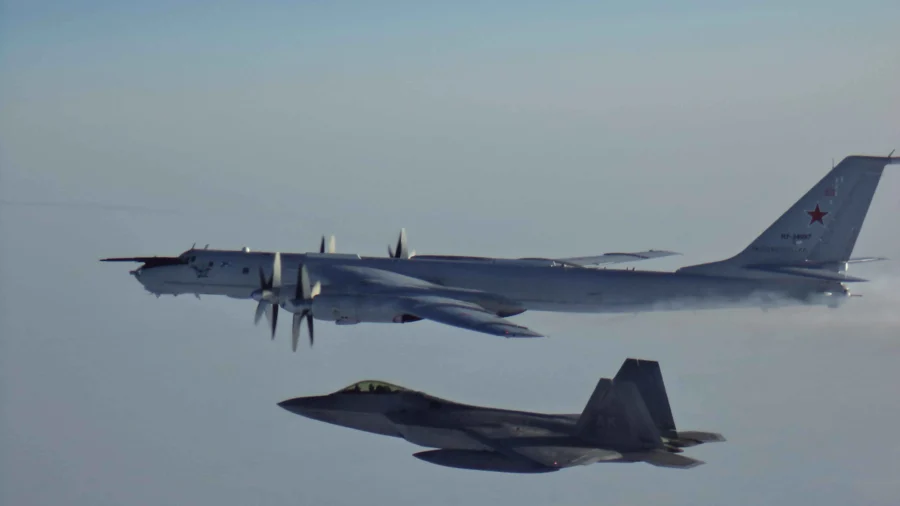
U.S. and Canadian defense officials said late Wednesday that two Russian military aircraft were found operating in the Alaskan and Canadian identification zones, prompting the Air Force to scramble jets in response.
A statement from the North American Aerospace Defense Command (NORAD) said U.S. and Canadian officials detected and tracked two Russian Tu-142 military planes earlier on Wednesday, an incident that NORAD described as routine.
"The Russian aircraft remained in international airspace and did not enter American or Canadian sovereign airspace," NORAD said. "This Russian activity in the Alaskan and Canadian ADIZ occurs regularly and is not seen as a threat."
Two U.S. Air Force F-35 fighter planes, two F-22 fighters, four KC-135 tanker planes, and one E-3 airborne warning and control aircraft were mobilized, while Canada sent two CF-18 fighter aircraft and one CC-150 tanker plane to monitor, identify, and intercept the two Russian planes in the identification zones.
The Alaska Air Defense Identification Zone, or ADIZ, is intended to serve as a buffer to warn of potential incursions by foreign aircraft. It extends hundreds of miles into the Bering Sea and the Arctic Ocean.
NORAD, which comprises both the U.S. and Canadian militaries, added in its statement that it "employs a layered defense network of satellites, ground-based and airborne radars and fighter aircraft to detect and track aircraft and inform appropriate actions," noting, "NORAD remains ready to employ a number of response options in defense of North America."
The Russian Tu-142, which has been in service since the early 1970s, is considered a reconnaissance and anti-submarine aircraft.
The incursion comes as the U.S. and Israeli militaries have conducted numerous airstrikes on Iran's military and leadership, killing the country's top leader, Ayatollah Ali Khamenei, over the past weekend. Iran has responded by firing barrages of rockets and drones at neighboring countries in the Middle East.
The incident near Alaska follows similar incidents in recent years. A similar encounter was reported in February after NORAD said military planes intercepted five Russian planes, including two Tu-95 bombers, two Su-35 fighter jets, and an A-50 early warning aircraft that were operating near the Bering Strait that separates Alaska and Russia's Far East.
NORAD, in response, sent F-35 and F-16 fighter planes along with E-3 tankers to identify and escort the Russian planes out of the area. The military said that the Russian planes stayed in international airspace and didn't enter U.S. or Canadian air identification zones.
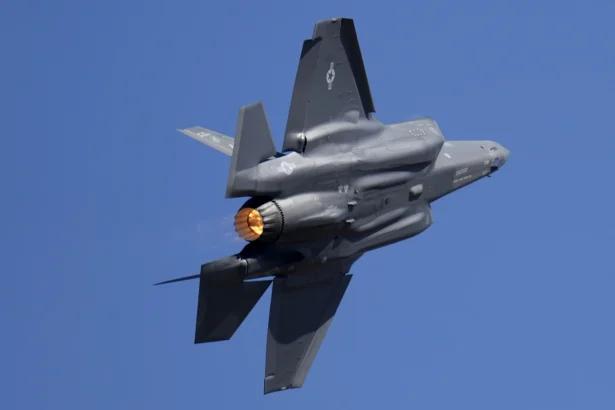
In September, U.S. fighter jets scrambled to identify and intercept four Russian warplanes flying near Alaska. NORAD said at the time that it detected and tracked two Tu-95s and two Su-35s operating in the Alaska air identification zone, prompting the U.S. military to scramble nine aircraft.
A year before that incident, in September 2024, NORAD criticized the Russian military after one of its Su-35 fighter jets was seen getting near an American jet. A U.S. military official said that the Su-35 engaged in "unsafe" and "unprofessional" conduct for the close fly-by.
NORAD is headquartered at Peterson Space Force Base, Colorado, but has its Alaska operations based at Joint Base Elmendorf-Richardson in Anchorage.