


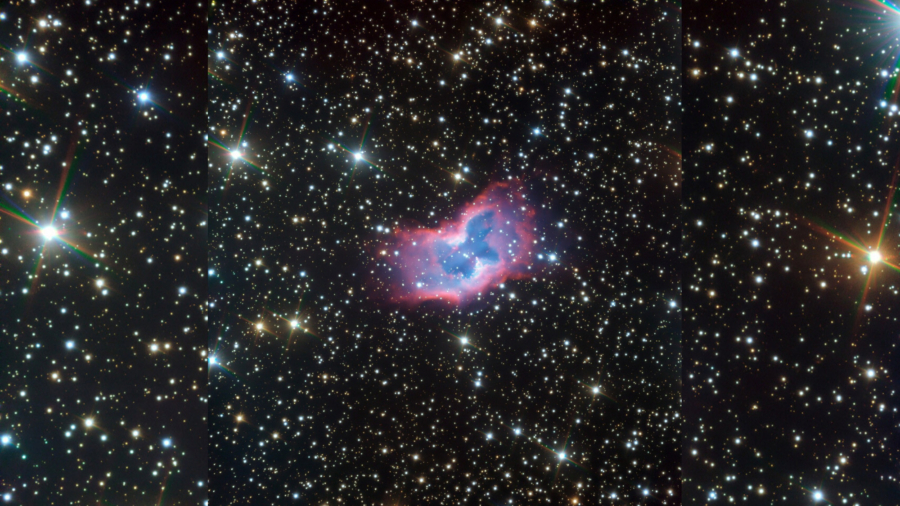
Thousands of light years away, there's a "space butterfly" colored with brilliant blues and clouds of purple and red. It's an image we've never seen in this much detail before.
So named for its resemblance to the winged insect, the "butterfly" is actually a planetary nebula—a giant cloud of gas that forms around an ancient star that hasn't yet exploded. The European Space Observatory's (ESO) aptly named Very Large Telescope, stationed in host country Chile, recently captured a vibrant image of the interstellar object.
It's known as NGC 2899 (NGC stands for New General Catalogue, which lists nebulae and other astral bodies like this one). It's located somewhere between 3,000 and 6,500 light years away from Earth in the constellation Vela, which is visible in the Southern Hemisphere.
This planetary nebula isn't long for this universe. Ultraviolet radiation lights up the shells of gas surrounding the star and causes them to shine quite brightly, the ESO said—but only for a few thousand years before they break up. That's a relatively short life span in astronomy.