


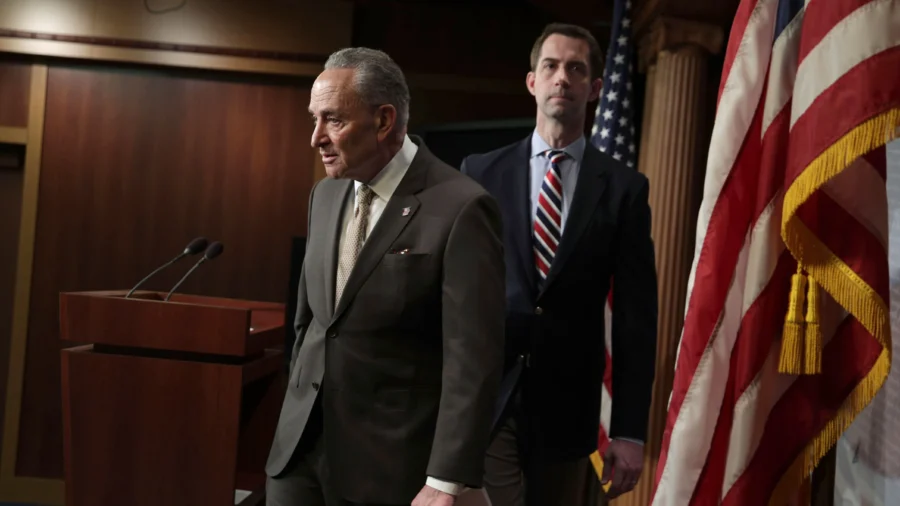
Sen. Tom Cotton (R-Ark.), the third-highest-ranking Republican in the U.S. Senate, and Senate Minority Leader Chuck Schumer (D-N.Y.), the highest-ranking Democrat in the Senate, on March 26 introduced bipartisan legislation that would bar the federal government from purchasing or operating ground-based robotics made by companies tied to the Chinese Communist Party and other adversary nations.
The American Security Robotics Act would prohibit executive agencies from procuring unmanned ground vehicle systems manufactured or assembled by entities linked to foreign adversaries. The ban covers humanoid robots, autonomous patrol technology, remote surveillance vehicles, and mobile robotics.
The bill would also block federal funds awarded through contracts, grants, or cooperative agreements from being used to acquire or operate the covered systems. Agencies that already own such systems would have one year after enactment to stop using them.
Rep. Elise Stefanik (R-N.Y.) introduced companion legislation in the House.
"Robots made by Communist China threaten Arkansans' privacy and our national security," Cotton said in a statement. "Our bill will ban the federal government from buying and operating these devices made in countries that wish us harm."
Schumer said Chinese firms backed by the Chinese Communist Party are "running their standard playbook—this time in robotics—trying to flood the U.S. market with their technology, which presents real security risks and threats to Americans’ privacy and American research and industry."
The bill includes exemptions for the Departments of Homeland Security, Defense, State, and Justice. Those agencies could still procure or operate the covered systems for research, cybersecurity testing, counterterrorism, or federal criminal investigations, provided the devices can no longer transmit data to or receive data from a covered foreign entity.
The legislation follows a pattern of bipartisan efforts to restrict Chinese-made technology in U.S. government systems.
Congress in December 2023 signed the American Security Drone Act into law as part of the National Defense Authorization Act for Fiscal Year 2024. That law banned federal agencies from procuring or operating unmanned aerial systems manufactured by covered foreign entities.
The law was overwhelmingly bipartisan, passing the Senate 87–13 and the House 310–118. It took effect in December 2025.
In related action that same month, the Federal Communications Commission added foreign-made drones and their components to its Covered List, blocking new models from receiving the equipment authorizations required for sale in the United States.
The FCC had previously used the same Covered List mechanism to ban new telecommunications equipment from Chinese firms Huawei and ZTE and surveillance equipment from Hikvision and Dahua, citing national security risks.
Several states such as Florida and Arkansas have enacted their own restrictions on Chinese-made drones for government use.
The new robotics bill arrives as Chinese firms compete with American companies in the emerging humanoid robot market.
At least two China-based firms, Agibot and Unitree, have plans to list their shares in China in 2026. A group of U.S. lawmakers last year urged the Pentagon to add Unitree to a list of firms that work with China's military.
Congress has weighed other measures as well. Sens. Bill Cassidy (R-La.) and Chris Coons (D-Del.) in November 2025 introduced the Humanoid ROBOT Act, which would similarly bar federal agencies and their contractors from using humanoid robots developed by entities in China, Russia, Iran, or North Korea.
The Cotton-Schumer bill defines "covered nation" by reference to existing federal law, which includes China, Russia, Iran, and North Korea.