


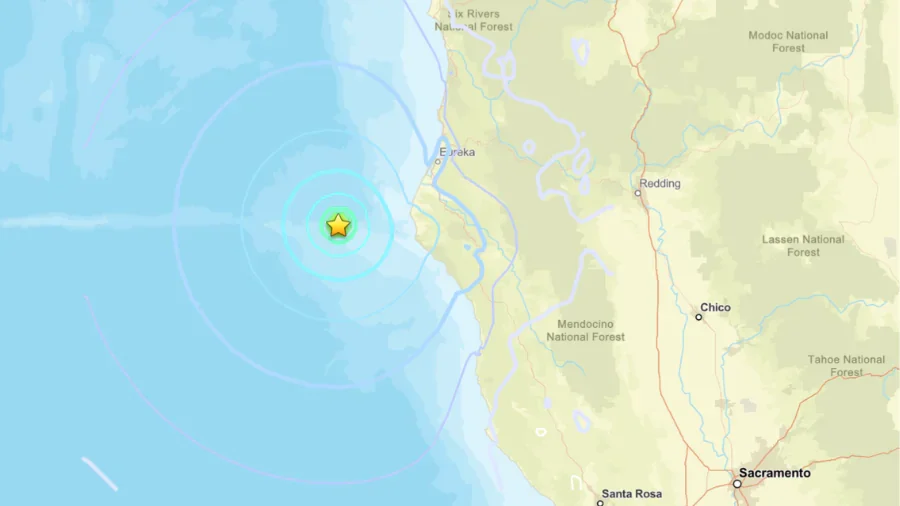
Several earthquakes jolted communities along the southern Oregon and northern California coasts early Wednesday morning.
Despite striking far offshore, some residents reported feeling weak to light shaking as far north as Reedsport, Oregon, and as far south as the Eureka, California, area.
"Didn't feel anything. Thankfully," one comment reads. "That's a big one."
The earthquake was followed by back-to-back quakes at 5:45 a.m. and 6:11 a.m. with magnitudes 5.1 and 4.5, respectively, striking offshore about 40 miles west of Petrolia, California.
The USGS received more than 100 reports of weak to moderate shaking related to the 5.1-magnitude quake, which was felt as far north as McKinleyville, near Eureka, and as far south as Branscomb. The quake was also felt farther inland near the unincorporated community of Fort Seward.
The same area was later hit by smaller earthquakes of magnitudes 2.8 and 3.9 at 8:05 a.m. and 8:50 a.m. No damage or injuries were immediately reported by local authorities related to any of the quakes, which were all fairly shallow, ranging in depth from about a tenth of a mile to 6.2 miles.
Magnitude is a good indicator of the size of an earthquake. However, depth can also influence how strongly shaking is felt above ground. The USGS notes that shallow earthquakes—which occur at depths of up to 43.5 miles—tend to produce stronger shaking because their seismic waves only have to travel a short distance to reach the Earth's surface, allowing them to retain more of their energy.
In the event of an earthquake, the USGS advises people to follow the "Drop, Cover, and Hold On" procedure. If indoors, residents should stay away from windows, fireplaces, and any heavy furniture, while those outdoors should move to an open area away from buildings, powerlines, or other objects that could fall.