


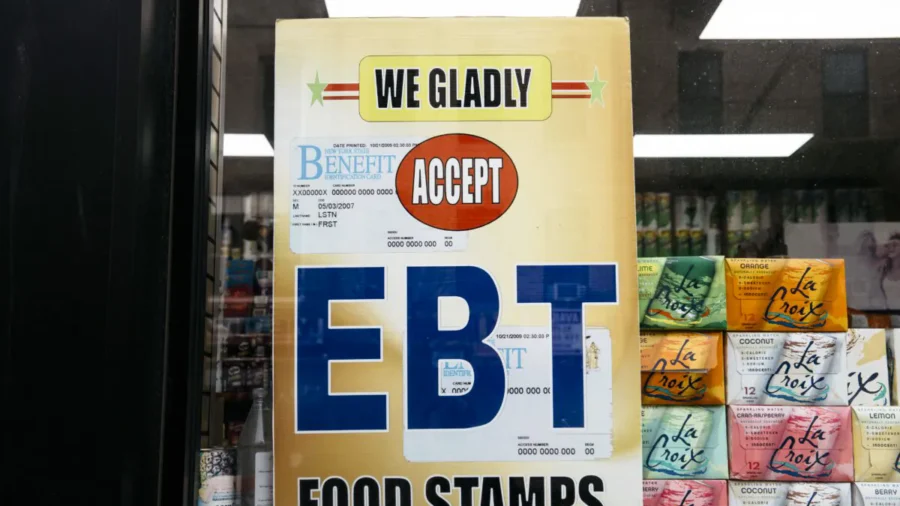
Nearly 4.3 million fewer people were receiving Supplemental Nutrition Assistance Program (SNAP) benefits in January 2026 compared with a year earlier, according to preliminary federal data.
The reduction in SNAP participation, also known as food stamps, followed Congress's approval of sweeping changes to the program through H.R. 1, the One Big Beautiful Bill Act. President Donald Trump signed the legislation into law in July 2025.
The law expanded work requirements, narrowed exemptions, and reduced eligibility for immigrants. It also required states to check eligibility more frequently. The Congressional Budget Office projects the bill will cut federal SNAP spending by $186 billion, or 20 percent, over 10 years.
Data from the U.S. Department of Agriculture (USDA) shows that SNAP participation fell from about 42.83 million people in January 2025 to roughly 38.55 million in January 2026—a decline of nearly 10 percent. Most of the decrease occurred after the law’s enactment.
The USDA reported that participation declined by about 743,000 people in six months, between January and June 2025. Then, the numbers dropped by roughly 3.47 million more in the following six months from July 2025 through January 2026.
USDA Agriculture Secretary Brooke Rollins attributed the drop to a stronger economy and tighter program oversight.
“A lot of it is people taking the program that shouldn’t have been," said Rollins. "And a lot of it is just a better economy. We’ve had wage growth that has outpaced inflation for the first time since early 2021. This is a really big day."
Roger Figueroa, an assistant professor at Cornell University who studies food insecurity, said the data suggest fewer people are receiving SNAP benefits because the program has become harder to access.
The CBPP says the drop is the steepest in decades, noting that the last comparable decline occurred nearly 30 years ago, after the 1996 welfare reforms. At that time, SNAP (then the Food Stamp Program) participation fell 9.4 percent—about 2.2 million people—between March and September 1997.