


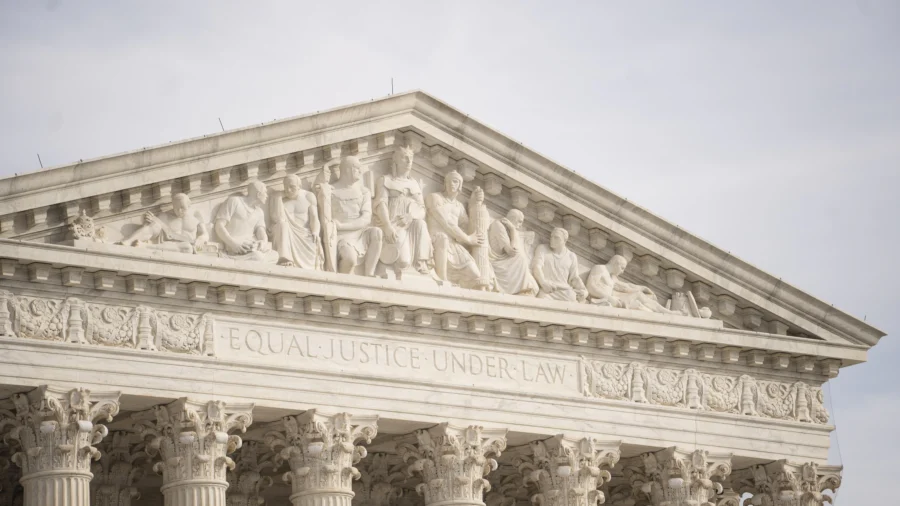
The U.S. Supreme Court on April 29 said a group of faith-based pregnancy centers can sue New Jersey in federal court to block a subpoena of their records.
In a unanimous ruling, the justices said the subpoena interfered with the pregnancy center's First Amendment right of free association.
New Jersey Attorney General Matthew Platkin was one of 16 attorneys general who signed onto a letter criticizing "anti-abortion crisis pregnancy centers," accusing them of deceiving patients who were seeking abortions.
Platkin issued the subpoena against First Choice Women’s Resource Centers in late 2023, accusing the organization of misleading its donors and consumers through false advertising. Platkin had alleged that although the organization's donor website touted its pro-life stance, its client websites were less explicit about its viewpoint.
Platkin also accused First Choice of providing false information by saying an ultrasound is "generally required before you take the abortion pill,” and by saying medical abortions can be reversed in some cases.
Among other records, Platkin demanded to see First Choice’s donor records. Such information is usually kept private to protect donors from pressure or retaliation.
Lower courts had ruled that First Choice could not bring its case in federal courts until a state court compelled obedience to the subpoena and addressed alleged violations of its constitutional rights.
In its briefs, First Choice told the Supreme Court that this created a “Catch-22” because of a legal doctrine known as res judicata, which prevents the relitigation of an issue that was already decided by another court.
Gorsuch noted that Platkin declined to adopt this position, as well as others taken by lower courts.
“Despite all this, the Attorney General insists that First Choice has not suffered any injury and thus cannot maintain this lawsuit for three reasons,” Gorsuch wrote.
Platkin’s first objection, he said, is that the subpoena was “non-self-executing” and could not chill First Choice’s free association rights until New Jersey state courts tried to enforce it. The justices did not buy that argument; the threat was enough, they said.
“Whether that command and those penalties were immediately enforceable or depended on subsequent court action, the most First Choice could say to existing and prospective donors after receiving Mr. Platkin’s subpoena was that their privacy might be protected—or it might not,” Gorsuch wrote.
Platkin’s logic would also result in a “preclusion trap,” Gorsuch said, because if First Choice lost in state court, res judicata would prevent the organization from bringing its case to federal court.
Platkin’s second argument was that “even if non-self-executing subpoenas can ‘objectively chill’ First Amendment rights, the subpoena he issued to First Choice did not,” Gorsuch wrote. The attorney general said this was because—even though the state wanted information about people who donated online, by phone, or in person—the state had no objection to donations made through one specific website.
The Supreme Court disagreed.
“A government that takes three limbs but spares the last imposes an injury all the same. So too here,” Gorsuch wrote.
He said that Platkin's logic would allow the state to funnel dissident opinions through “narrow and state-preferred” forums.
Platkin’s final argument—a promise that the state would keep the donor information secret—didn’t survive either.
Gorsuch was skeptical that such privacy could be enforced in the modern age, when information can easily be leaked onto the internet. But that isn’t the only problem; the mere threat of a leak would hinder First Choice’s work.
“An official demand for private donor information is enough to discourage reasonable individuals from associating with a group,” Gorsuch wrote.
The decision is the 18th victory at the Supreme Court for legal advocacy group Alliance Defending Freedom, which represented First Choice.
Erin Hawley, who argued the case in December 2025, said the group looks forward to arguing the case in federal court, should New Jersey decide to persist.
“New Jersey’s attorney general targeted First Choice—a ministry that provides parenting classes, free ultrasounds, baby clothes, and more to its community—simply because of its pro-life views,” Hawley said in a statement emailed to The Epoch Times. “That is blatantly unconstitutional.”
In January, Jennifer Davenport replaced Platkin as New Jersey’s attorney general. The Epoch Times reached out to her office for comment on the April 29 ruling but received no response.