


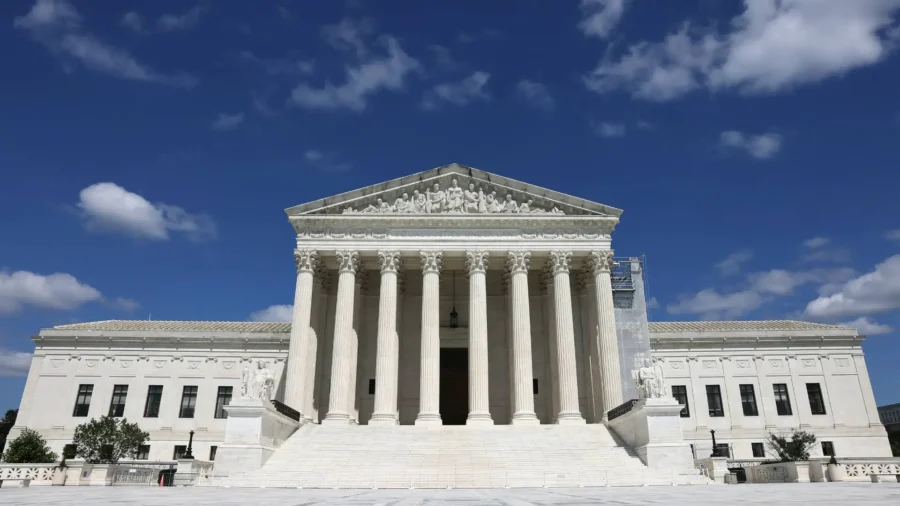
The Supreme Court on Sept. 26 extended its prior order letting the Trump administration temporarily withhold approximately $4 billion in foreign aid funding previously authorized by Congress.
The case is U.S. Department of State v. AIDS Vaccine Advocacy Coalition and Global Health Council v. Trump.
The money is earmarked for foreign aid and United Nations peacekeeping projects. Various nonprofit groups applied to the courts to free up the funds.
The Supreme Court said in its new order that the federal government had made a strong enough case that the federal Impoundment Control Act bars a lawsuit seeking to force the government to spend the funds.
The court also said the harms the executive branch faces from interference in the conduct of the nation’s foreign affairs “appear to outweigh the potential harm faced by respondents.”
The high court said that Ali’s order of Sept. 3 granting a preliminary injunction requiring the government to spend the funds is stayed pending an appeal that is currently before the U.S. Court of Appeals for the District of Columbia Circuit.
Dissenting Opinion
In her dissent, Kagan said the Supreme Court was in “uncharted territory” because the meaning and effect of the impoundment statute have barely been examined by the courts.She said the issue, which is how power is allocated between the executive branch and Congress over the expenditure of public funds, is important, yet the Supreme Court “has dealt with the statute only in passing.”
Kagan said the president has asked Congress to formally rescind the $4 billion in foreign aid appropriations, but lawmakers have not yet acted on the request. Because the district court order requiring the funds to be spent by Sept. 30 has been suspended by the Supreme Court, “the effect is to prevent the funds from reaching their intended recipients—not just now but (because of their impending expiration) for all time.”
Kagan said the “standard for granting emergency relief is supposed to be stringent. The Executive has not come close to meeting it here.”
The high court’s order will allow the executive branch “to cease obligating $4 billion in funds that Congress appropriated for foreign aid, and that will now never reach its intended recipients.”
Because this outcome “conflicts with the separation of powers, I respectfully dissent,” Kagan said.
The separation of powers is a constitutional doctrine that divides the government into three branches to prevent any single branch from accumulating too much power.