

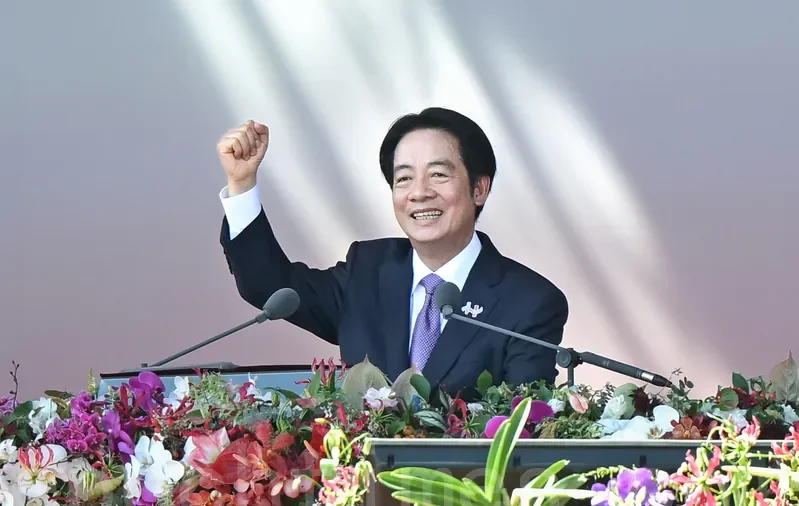
TAIPEI, Taiwan—President Lai Ching-te has said Taiwan could play a bigger role in global health efforts if the island were allowed to join the World Health Organization (WHO).
As Taiwan’s first president with a medical background, Lai said he was eager to build a “healthy Taiwan,” saying that the island has much to contribute to digital health and artificial intelligence (AI) governance, cancer policy and innovation, and global efforts to eliminate hepatitis C.
“Taiwan's booming digital health industry will keep driving innovation. With tools like medical AI and robotics, and even the medical metaverse, we can enhance precision health and quality of care in every way,” Lai said.
To better prevent and treat cancer, the president said that Taiwan has been strengthening early screening and precision medicine and improving access to innovative treatment. As for hepatitis C, Lai said the island has achieved the elimination targets ahead of the WHO’s 2030 target year.
“With the health challenges we face today, no country can act alone,” he said. “For many years, Taiwan has been an active part of global health. As a responsible and reliable partner, we are committed to sharing our experiences and working closely with the international community.
“By joining the WHO, Taiwan could better ensure the right to health for all our people, and do even more to support the rest of the world.”
Taiwan is not a member state of the WHO. From 2009 to 2016, it participated in the WHA—the WHO’s decision-making body—as an observer. Since 2017, however, Taiwan has not been invited to attend, amid Beijing’s objections.
Although China’s communist regime has never ruled Taiwan, Beijing considers the self-governing island part of its territory and opposes any move that could be seen as legitimizing Taiwanese sovereignty. Beijing has therefore routinely blocked Taiwan’s participation in international organizations and pressured foreign governments to avoid official engagement with Taipei.
On May 18, WHO member states rejected a proposal to invite Taiwan to the WHA after China said it would block the island’s participation.
“China does not agree to the participation of China's Taiwan region in the WHA in any form,” a Chinese delegate told member states.
Palau and Paraguay, two of Taiwan’s diplomatic allies, spoke in favor of Taiwan’s participation in the international health body.
“Global health governance cannot afford gaps—excluding any capable and responsible partner, including Taiwan, creates precisely such a gap,” a delegate from Palau said.
“Taiwan's exclusion from WHO is unjustified and harmful. It weakens global disease surveillance, delays information sharing, and undermines collective preparedness.”
A delegate from Paraguay said Taiwan “has proven itself to be a responsible and effective partner in public health.”
“Taiwan should be invited to participate in the World Health Assembly as an observer and to meaningfully join in the meetings, mechanisms, and activities of the WHO,” the Paraguayan delegate added.
The report also highlights how early warnings from Taiwan were “substantially ignored” by the WHO because of the island’s lack of recognition as a member state and “pressure from China.”
“Taiwan notified the WHO as early as December 31, 2019, asking for more information about atypical pneumonia cases reported in Wuhan. The WHO never followed up with information,” the report reads.
Taiwanese Foreign Minister Lin Chia-lung and Health and Welfare Minister Shih Chung-liang have traveled to Geneva with Taiwan's delegation. Chinese foreign ministry spokesperson Guo Jiakun criticized the trip.
Hsiao Kuang-wei, a spokesperson for Taiwan’s foreign ministry, responded to Guo’s comment on May 19, telling Taiwan’s national media, Central News Agency (CNA), that China has no right to represent Taiwan internationally, including at the WHA.
Shih told CNA that Taiwan’s delegation encountered signs of pressure from Beijing while attending side events at the WHA, including suspected Chinese nationals allegedly tracking the group’s movements during a Taiwan-organized walking event.