


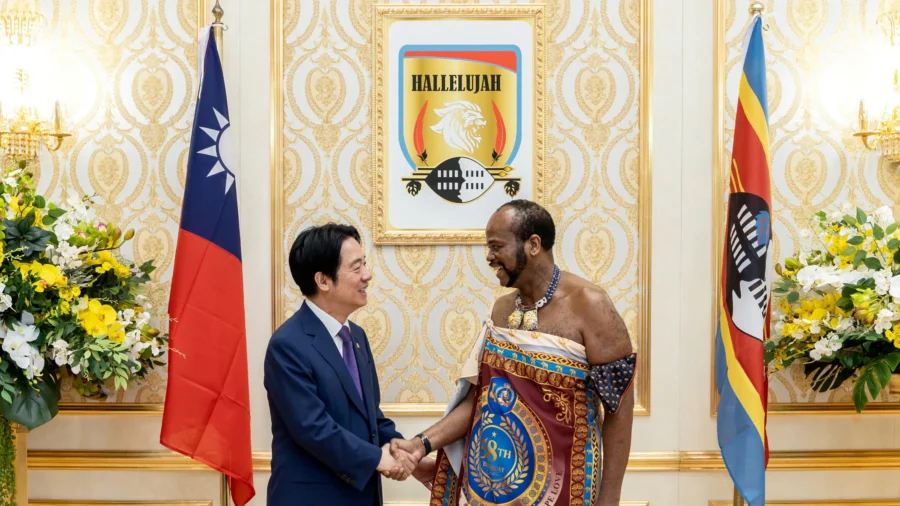
TAIPEI, Taiwan—Taiwanese President Lai Ching-te arrived in Eswatini, formerly known as Swaziland, for a state visit on May 2, resuming a trip that had been initially canceled because of interference from Beijing, which drew international criticism for its efforts to undermine the island’s global standing.
Lai is visiting Eswatini, one of 12 countries that maintain formal diplomatic relations with Taipei, to celebrate the 40th anniversary of King Mswati III’s accession to the throne, as well as his 58th birthday.
“The Republic of China, Taiwan, is a sovereign nation and a Taiwan that belongs to the world,” Lai told the king on May 2, in comments provided by Taiwan’s presidential office on May 3. The Republic of China is Taiwan’s official name.
“The 23 million people of Taiwan have the right to engage with the world, and no country has the right—nor should any country attempt—to prevent Taiwan from contributing to the world.”
China’s action drew international criticism, including from the U.S. State Department, the European Union, Paraguay, and Saint Kitts and Nevis. The Inter-Parliamentary Alliance on China, a coalition of more than 200 lawmakers worldwide, said in a statement that Lai “must be free to engage with partners without interference” and that “it is not for Beijing to determine the foreign policy of other countries.”
On May 2, Lai arrived in the southern African nation on a plane provided by the government of Eswatini.
Neither government announced the trip before Lai’s arrival.
Lai’s trip followed the so-called “arrive then announce” model, Taiwan’s national media outlet, Central News Agency, reported on May 2, citing national security officials. The model is common in high-level diplomacy to minimize the risk arising from potential external interference, the outlet stated.
In China, the foreign ministry’s spokesperson criticized Lai’s trip, calling his action “undignified,” while reiterating that “Taiwan is part of China,” according to a May 2 statement.
The Chinese Communist Party has never ruled Taiwan, but has insisted on regarding the island as a “renegade” Chinese province.
Responding to the Chinese regime’s condemnation, the Taiwanese Ministry of Foreign Affairs called China a “troublemaker” that “distorts international rules,” according to a statement released on May 2.
“Taiwan, as a member of the international community, has the fundamental right to visit its allies in accordance with international rules, and this is a perfectly natural and normal matter,” the ministry stated. “It is China’s unreasonable interference, pressure on vulnerable countries, and destruction of international norms that are causing problems.”
Lai’s arrival in Eswatini has also drawn international attention.
U.S. Sen. Rick Scott (R-Fla.), who serves on the U.S. Senate Foreign Relations Committee, said he was glad to see Lai touch down safely in Eswatini.
“Communist China’s stunt to intimidate Taiwan FAILED,” Scott wrote in an X post on May 2. “Freedom WILL prevail.”
Scott also responded to media reports that some European countries had also denied Taiwan’s request for transit stops en route to Eswatini.
“To the SPINELESS world leaders across Europe and elsewhere who caved to Communist China, the world took note,” Scott wrote. “America won’t forget.”
Benedict Rogers, founder of UK nongovernmental organization Hong Kong Watch, said he was “glad” that Lai made the trip to Eswatini despite Beijing’s “efforts to scupper it,” according to his X post on May 2.
During their meeting, Lai and the king of Eswatini witnessed the signing of a joint communique to strengthen collaboration and enhance trade relations between the two sides.