



Tariffs also increased under the Section 301 China tariff policy, rising by an additional 20 percentage points over the existing tariff rates.
Some items, like semiconductors and EVs, are tariffed at higher rates. These increases were announced by the Biden administration in May 2024 and have been in effect since September.
There are more tariffs to come.
What Are Tariffs and How Do They Work?
Tariffs are extra charges imposed on imported goods by a country’s government. While rare, some countries use export tariffs to control domestic supply, but the U.S. Constitution prohibits that.A tariff is paid by the importer, often through a customs broker, when goods enter a country. Tariff rates vary depending on the product and country of origin.
All countries have tariffs. Even free trade partners often maintain some tariffs on specific goods or industries.
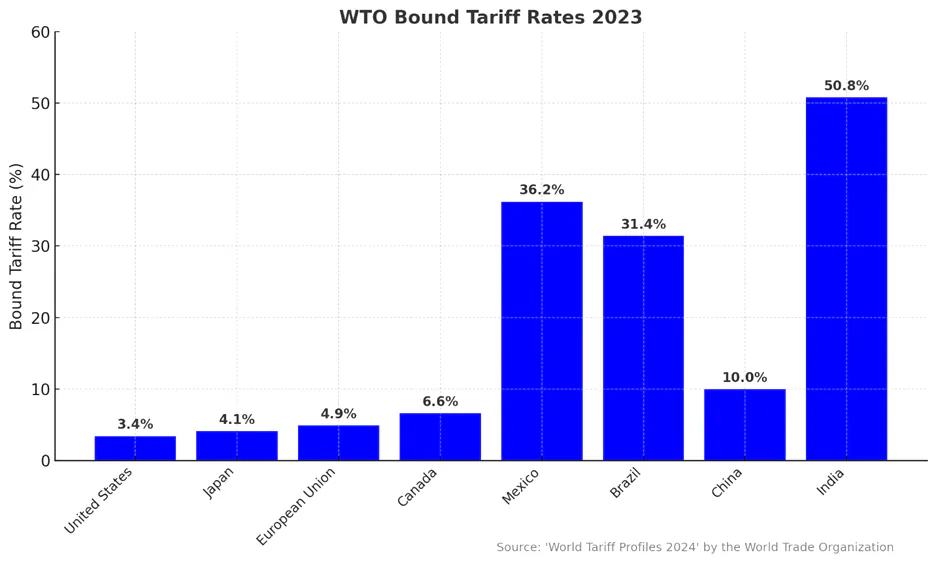
By comparison, Mexico charges non-WTO members a 36.2 percent tariff, while WTO members are charged 6.8 percent. China has a 10 percent tariff for non-members and a 7.5 percent tariff for WTO members. Hong Kong, which is a services economy, has no tariffs at all.
- Revenue Generation—Before income taxes, tariffs were a primary source of government funding.
- Industrial Protection—Tariffs helped build American manufacturing by shielding domestic industries from foreign competition, particularly when Britain and Europe dominated global production.
- Importers pay tariffs. Importers sometimes hire customs brokers to manage tariff payments when goods cross the border. Currently, customs brokers are mainly asking companies in Mexico, Canada, and the United States to deposit cash upfront to pay these new tariffs.
- Sometimes a company passes the extra cost onto consumers, either by raising prices, absorbing the cost through reduced profit margins, or adjusting supply strategies, such as modifying order volumes or new financing terms. This means that a 25 percent tariff on a $100 import does not become a $125 good.
Mexico and Canada Tariffs: Why Enacted and Will They Stay?
Trump first threatened tariffs on Mexico and Canada on Feb. 1, citing the border and fentanyl crises. He gave both countries one month to prepare for tariffs. At the time, he alluded to the possibility of avoiding tariffs if Mexico and Canada helped stop the flow of fentanyl across the border.Canadian oil and gas will see a 10 percent tariff instead of duty-free rates, while all agricultural goods will be tariffed at 25 percent beginning April 1. The United States has become a net importer of food.
It is unclear why the White House is sticking with these tariffs on Mexico and Canada.
The Trump administration stated it also wants to use tariffs to rebalance trade with countries where it has persistent and growing trade deficits in manufactured goods.
Earlier this week, car manufacturer Honda reportedly announced that it will produce its next-generation Civic hybrid in Indiana, instead of Mexico, to avoid future tariffs risks.
If the White House is focusing on rebalancing the Mexico-Canada trade relationship, meaning fewer imports and more domestic manufacturing, then these tariffs could be here to stay.
China Tariffs Doubled
China tariffs were supposed to go up by only 10 percentage points but went up a surprising 20 percentage points instead. The White House cited China’s sale of pre-cursor chemicals used in making fentanyl to the Mexico drug cartels as the reason for the tariff increase.China was already subject to as much as a 25 percent tariff under the Section 301 tariffs that began in 2018 and were extended another four years in 2024 by the Biden administration.
The China tariffs were broken down into lists. After the first Trump administration reached the so-called Phased One trade agreement, one of those listed items fell to 7.5 percent. But after Tuesday, those items will increase to 27.5 percent.
How Steel and Aluminum Tariffs Worked in the Past
Trump first imposed Section 232 steel and aluminum tariffs in 2018. This included Mexican and Canadian steel.Initial 2018 tariffs boosted production, investment, and employment.
But domestic steel production fell from its peak production in 2019 of 87.8 million metric tons to 79.5 million tons in 2024, based on U.S. Department of Commerce figures. Country and product exemptions weakened the tariffs’ effectiveness, resulting in U.S. companies lowering production levels at steel mills as their buyers were now competing with imports from lower cost countries like Brazil and Mexico.
Some local aluminum producers have argued that the initial 10 percent tariff in 2018 was insufficient. The industry reduced from over 20 aluminum producers in 2000 to only four today.
Companies that make goods from aluminum, like manufacturers of piston rods for automotive, successfully convinced the Trump administration that doubling the tariff was needed and new aluminum-derived products had to be added.
New Section 232 tariffs increase next week with new steel and aluminum products added.
Countries that were exempt from Section 232 tariffs in favor of an import quota system will no longer be exempt. This includes the removal of exemptions for Argentina, Australia, Brazil, Canada, Japan, Mexico, South Korea, the European Union, the United Kingdom, and Ukraine.
Will Tariffs Lead to Higher Inflation?
The first round of China tariffs in 2018 did not lead to any meaningful impact on inflation. Core inflation in 2017 was 1.9 percent, rising to 2.2 percent in 2018 and then 2.3 percent in 2019 after one full year of tariffs.In March 2023, the U.S. International Trade Commission (ITC) published a 318-page report on the impacts of the Section 232 and Section 301 tariffs.
- U.S. production of steel and aluminum increased by 1.9 percent and 3.6 percent on average, respectively, during this period.
- In dollar terms, U.S. production of steel and aluminum was on average $1.5 billion and $1.3 billion higher each year, respectively, than it would have been without the tariffs.
- The tariffs are estimated to have increased the average price of steel and aluminum in the United States by 2.4 percent and 1.6 percent, respectively.
- Section 301 tariffs resulted in the value of U.S. imports from China dropping 13 percent on average in the top 10 sectors affected by the tariffs.
- Prices rose between 0.2 percent and 0.4 percent on average.
It estimated that if China tariffs hit 60 percent and Trump imposes an additional 10 percent tariff on imports globally, inflation could see a one-time increase of 2.2 percentage points before settling down.