


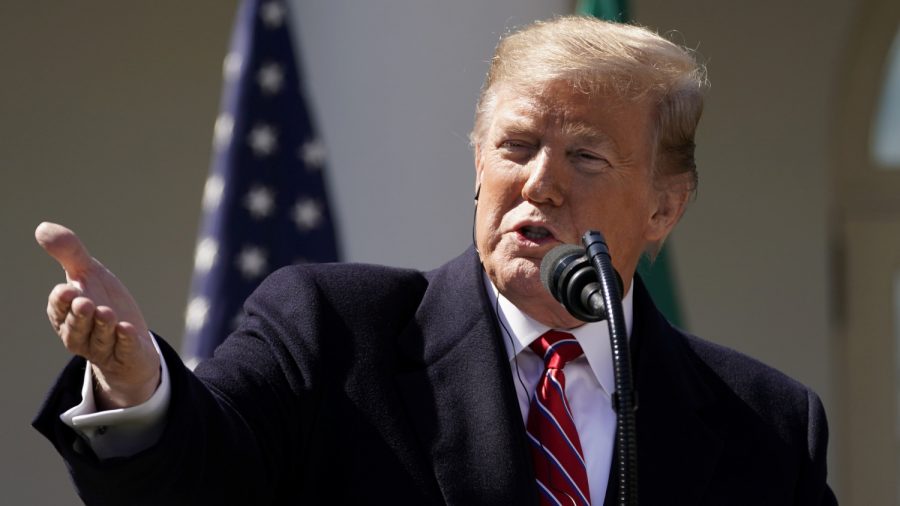

- President Donald Trump and Senate Republicans are setting historic records for appeals court confirmations.
- Trump’s nominees have skewed the circuit courts rightward and might flip two appellate courts to majority Republican control by the end of 2019.
- Despite success at the circuit court level, vacancies on federal trial courts have ballooned, as have the number of courts classified as so-called “judicial emergencies.”
As of this writing, the president has appointed 102 judges to the federal bench. That total includes 63 trial judges, 37 appeals judges and two Supreme Court justices.
“Today marks an incredible milestone as the Senate confirmed President Trump’s 100th judicial nominee,” said Carrie Severino, chief counsel of the Judicial Crisis Network. “This is a big win for the country to have judges who fairly apply the law and adhere to the Constitution sitting on our nation’s most prized courts.”
Though Trump and the Senate Republican caucus have processed nominees with stunning proficiency, the administration has not yet overcome left-leaning majorities on many federal appeals courts, while a burgeoning number of trial court vacancies present a daunting challenge.
The Senate reached the 100-judge mark with the confirmation of Rodolfo “Rudy” Armando Ruiz to the U.S. District Court for the Southern District of Florida on a 90-8 vote. Ruiz is a state court judge and a member of the Federalist Society, a conservative legal group that advises the White House of judgeships. The confirmations of Raul Manuel Arias-Marxuach to the District of Puerto Rico and Joshua Wolson to the Eastern District of Pennsylvania followed.
With 37 appointments to the circuit courts, Trump and GOP lawmakers have set a record for appellate confirmations. By way of comparison, former President Barack Obama had 18 circuit court appointments at this juncture of his presidency, while former President George W. Bush had 30.
That astounding clip was enabled by a sequence of changes Republican lawmakers made to Senate process over bitter Democratic objections. The Republican-led Senate Judiciary Committee has held at least a dozen hearings in which multiple circuit nominees testified before the panel, a break from prior practice in which appellate nominees generally appeared before the committee one at a time.
The Judiciary Committee has also eschewed the so-called blue slip system for appeals court nominees. The blue slip protocol provides that the Judiciary Committee will not convene a hearing for a nominee until senators return an opinion on a nominee selected for a federal court in their state. Republicans say that rule has been enforced erratically in the modern period.
Yet the reach of Trump’s judicial confirmations is limited in an important respect—many of his nominees are themselves succeeding Republican appointees on appeals courts where right-leaning judges are already in the majority.
![Senate Majority Leader Mitch McConnell [R-Ky.] speaks during an interview with Reuters in Washington, on Oct. 17, 2018. (Joshua Roberts/Reuters)](https://i.ntd.com/assets/uploads/2019/02/USA-SENATE-MCCONNELL-1200x917.jpg)
While progress has been slow on left-leaning benches, Trump may flip an important appeals court to majority Republican appointees by year’s end. Judge Christopher Droney of the 2nd U.S. Circuit Court of Appeals, a Bill Clinton appointee, announced in April that he will take senior status, a form of quasi-retirement that allows judges to leave regular service while still participating in cases on a limited basis.
With Droney’s departure, there will be four vacancies on the 2nd Circuit, though Michael Park’s imminent confirmation will reduce that figure to three. If Trump nominees fill the three remaining seats, GOP appointees will have a 7-6 majority on the 2nd Circuit, which covers Connecticut, New York, and Vermont.
All told, Trump’s nominees have indisputably rotated a more conservative cast into the federal courts, according to University of Richmond School of Law Professor Carl Tobias, who studies judicial selection.
“Trump’s judges have made most circuit courts more conservative, except for the Boston and Washington, D.C. based appeals courts,” Tobias said. “The 3rd U.S. Circuit Court of Appeals is the only panel that has ‘flipped’ to majority Republican appointees.”
The 3rd Circuit is the federal appellate court for Delaware, New Jersey, Pennsylvania, and the Virgin Islands. Trump has made three appointments to that panel.
Whatever the benefits of the GOP’s push for appellate nominees, the administration has struggled to manage the growing number of trial court vacancies, though the April rule change may renew Republican interest in those judgeships.
“Though nominations have kept pace with retirements at the circuit court level, they have not kept pace for trial courts,” Tobias told TheDCNF.
“Trump has not prioritized judicial emergencies, which is a big mistake because by definition they have the greatest need,” Tobias said. “Since Republicans took the Senate majority, emergencies have soared from 12 to as high as 88 and are now at 82.”
After Thursday’s confirmations, McConnell teed up Park’s confirmation vote for the 2nd Circuit. Final action will follow in the coming days.