


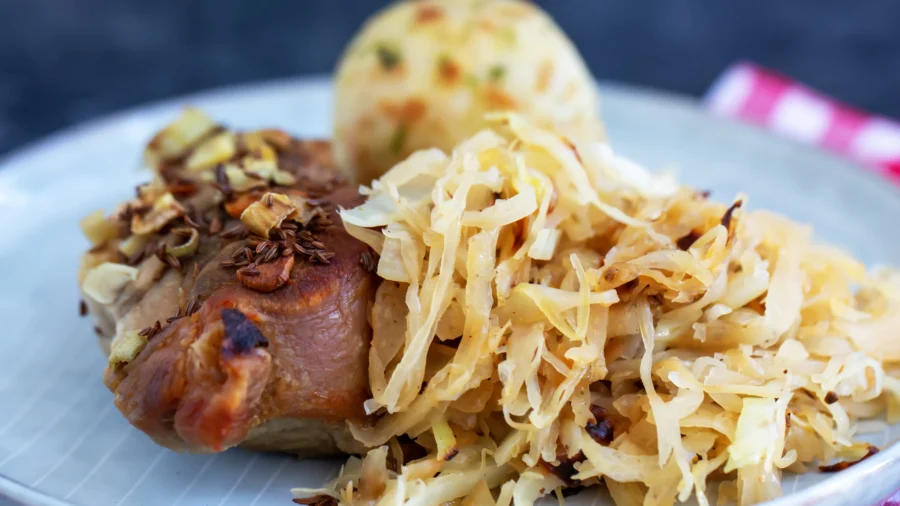
When the clock strikes midnight and the calendar turns to 2026, many people around the world will celebrate the new year by consuming tradition-rich food.
From pork and sauerkraut, pickled herring, and lentil soup to black-eyed peas, tamales, and grapes, culinary traditions vary from country to country, and even region to region. They carry the same purpose of welcoming good health and fortune, and leaving behind troubles from the year that has passed.
The most iconic food to celebrate the new year in the United States and many European nations is pork and sauerkraut—a dynamic duo that has served as a staple for generations.
Indeed, pigs have long been seen as a symbol of good fortune and progress, according to Schmidt Sausage Haus, a Columbus, Ohio-based family owned business. Established in 1886, it has a restaurant in the city’s German Village, and multiple food trucks that appear at events across Ohio. Its Schmidty’s blog highlights the cultural stories behind German culinary traditions.
The word sauerkraut means “sour cabbage,” and the tangy fermented cabbage dish represents abundance and preservation.
When much of the population lived off their own land decades ago, pork and sauerkraut were timely for New Year’s Day. The cabbage harvest peaks around October, and sauerkraut involves a fermentation process of at least six to eight weeks. Families would can their harvests to have enough food for the winter months, according to a blog post from Stoltzfus Meats, which is based in Lancaster County, Pennsylvania.
The butchering of animals also typically happened in late fall or early winter, just in time for fresh roasts for the new year.

The delicacy includes crumbled pork sausage and cream cheese as binders, with chopped onions and sauerkraut as the main components of the filling. Garlic, parsley, pepper, salt, and yellow mustard are typically mixed in as seasoning.
The balls are often rolled in Italian breadcrumbs, eggs, flour, and milk, and fried in oil.
Some residents of Akron claim that sauerkraut balls originated in their community. In 1996, Akron Beacon-Journal readers voted for it as the city’s official food.
Judy Orr James’s 2022 cookbook “Akron Family Recipes” has an entire chapter on sauerkraut balls, subtitled “It’s an Akron Thing.”
Down South
Down South, black-eyed peas are a New Year’s Day tradition.Some people suggest that black-eyed peas symbolize the expansion of wealth throughout the year because they swell when cooked. Others cite the old adage, “Eat poor on New Year’s, and eat fat the rest of the year.”
Black-eyed peas are an essential ingredient in Hoppin’ John, a dish slowly simmered with rice and often flavored with smoked pork and spices, served with collard greens and cornbread.

Spain
Bowls of grapes adorn the tables of living rooms in homes across Spain as midnight approaches on New Year’s Eve. When the clock strikes midnight, people eat one grape with each chime symbolizing good luck for each month of the new year.The tradition is called “las doce uvas de la suerte,” or the 12 grapes of luck.
Canada
Tourtiere is a French Canadian meat pie typically served on Christmas Day or New Year’s Day.Greece
In Greece, pomegranates are smashed at the door to represent fertility and prosperity. The seeds are scattered to symbolize the family’s good fortune for the new year.
Jan. 1 is also the Feast of St. Basil, celebrated to commemorate the early Christian theologian.
Japan
Toshikoshi soba means “year-crossing buckwheat noodles.” In Japan, New Year’s Eve is celebrated with a warm bowl of thin soba noodles served in a broth and often topped with green onions or tempura.The long noodles signify the wish for a long life. The noodles are fragile and easy to cut, which represents letting go of the past year’s challenges.
Italy
A traditional New Year’s Eve feast in Italy features a bowl of stewed lentils topped with slices of cotechino (Italian pork sausage) or zampone (stuffed pig’s trotter). The lentils are typically simmered until tender in a broth with carrots and onions and served when the clock strikes midnight.Scandinavia
In countries like Norway and Sweden, a forkful of pickled herring is traditionally eaten at the beginning of the new year.The small silvery fish is cured in brine and vinegar with onions, spices, and sugar.

Ireland
The Irish have a tradition of banging the walls of their houses with bread to chase away bad luck and evil spirits, and then gathering to eat the bread to bring in the new year.Netherlands
On New Year’s Eve in the Netherlands, families set out a platter of Oliebollen, or oil balls. The fried dough balls are stuffed with currants or raisins and dusted with powdered sugar. Eating them is said to ward off evil spirits and offer protection for the year ahead.Mexico
The arrival of the new year in Mexico is traditionally celebrated with steaming tamales, which are pockets of corn dough filled with pork or chicken, wrapped in corn husks or banana leaves, and steamed.Platters of tamales are served as a part of the late-night feast on New Year’s Eve.
The preparation of tamales is time-consuming, so each person in the family takes on a role, like preparing the filling and wrapping. The process evokes togetherness among many Mexican families because of the time involved in making the tamales.