


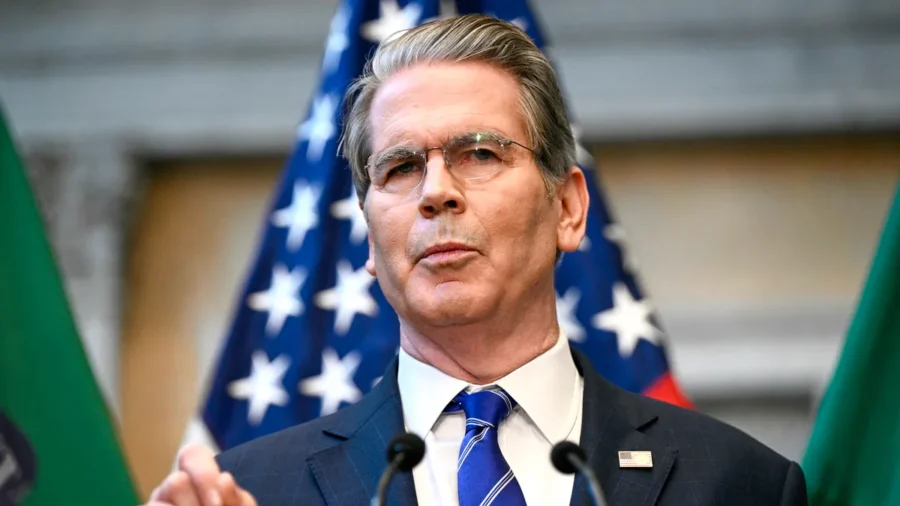
Treasury Secretary Scott Bessent said that the $2,000 tariff revenue dividend proposed by President Donald Trump could come in the form of lower taxes.
“It could be just the tax decreases that we are seeing on the president’s agenda. You know, no tax on tips, no tax on overtime, no tax on Social Security,” Bessent also told the network, adding that those items are “substantial deductions” that are currently “being financed in the tax bill.”
The Supreme Court is currently considering the legality of a number of the Trump administration’s tariffs. Earlier this year, the president declared a national emergency under the 1977 International Emergency Economic Powers Act (IEEPA), which has been subject to multiple lawsuits.
As some of the justices sounded skeptical of the government’s arguments in favor of the tariffs under the emergency law, Trump was asked during a White House event on Nov. 6 what he’d do if the high court overturned the import taxes.
“It would be a shame. It would be somewhat catastrophic for our country,” Trump told reporters.
“We are taking in Trillions of Dollars and will soon begin paying down our ENORMOUS DEBT, $37 Trillion. Record Investment in the USA, plants and factories going up all over the place,” he wrote. “A dividend of at least $2000 a person (not including high income people!) will be paid to everyone.”
During his first administration, Trump backed stimulus checks under the CARES Act, which was passed in 2020 during the COVID-19 pandemic. He later backed smaller stimulus checks under the Consolidated Appropriations Act.
Earlier in November, Bessent said that he expects the Supreme Court to uphold the IEEPA-based tariffs. If it strikes down the tariffs, Bessent said, the administration will switch to other tariff authorities, including Section 122 of the Trade Act of 1974, which allows broad 15 percent tariffs for 150 days to calm trade imbalances.
Bessent said Trump can also invoke Section 338 of the Tariff Act of 1930, a statute that allows tariffs of up to 50 percent on countries that discriminate against U.S. commerce.
“You should assume that they’re here to stay,” he said of Trump’s tariffs.