


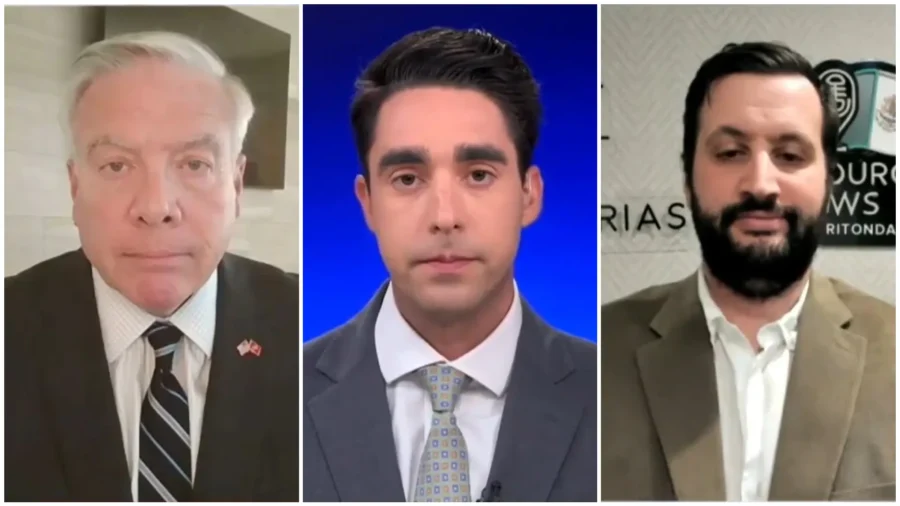
Retired Lt. Col.Hal Kempfer, chief executive officer of Global Risk Intelligence and Planning, and Stefano Ritondale, chief intelligence officer for Astorias, joined a panel discussion with NTD's Jack Bradley.
Kempfer discussed President Donald Trump's announcement of the postponement of planned strikes against major energy and electricity plants in Iran, the implications of U.S. strikes on Iran's power plants, particularly in Tehran, which has a water crisis, and would have caused a major crisis in Iran.
Ritondale said the possible strikes against energy infrastructure were designed to get Iran to negotiate seriously on the Strait of Hormuz, which appears to have worked, and the military continues to operate under the same construct even with an energy cease-fire.
Kempfer said U.S. talks with an Iranian leader are likely with the parliamentary speaker, Mohammad Bagher Ghalibaf. He said that U.S.-Israeli strikes have put the Iranian regime in disarray, which opens new avenues of thinking and discussion and goes toward the goal of opening the Strait of Hormuz.
Ritondale said there are a lot of different factions in Iran, and the Trump administration is trying to find moderates within the regime to get a deal specific to the Strait of Hormuz.
The panel also discussed the president's comments about potentially controlling the Strait jointly with the Iranian leadership.
Kempfer said that isn't a serious consideration because Iran doesn't have a Navy anymore, and the U.S. needs NATO allies and Japan, which have mine-sweeping capabilities, to assist with the Strait of Hormuz. He said he thinks some combined task force of more than two nations will be in charge of the Strait.