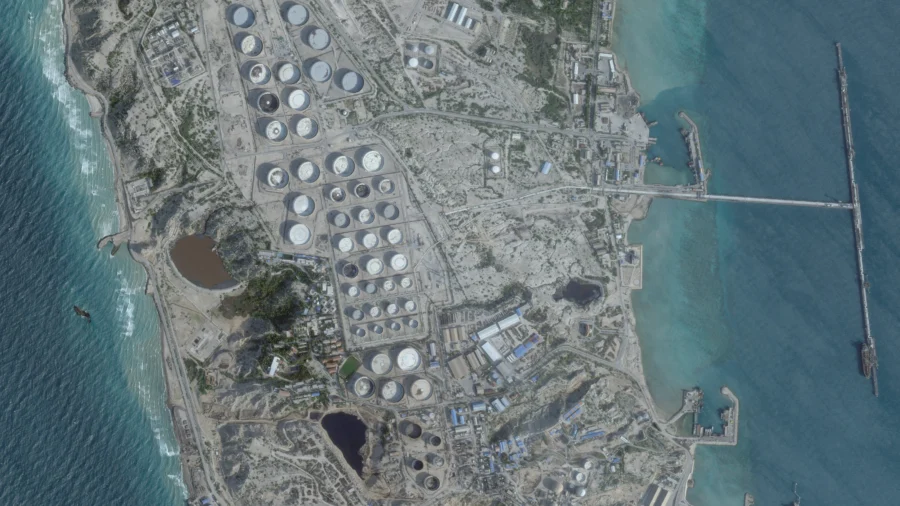
President Donald Trump on March 29 suggested that he was considering taking Iran’s oil and seizing Kharg Island, Tehran’s key oil export hub, as thousands of U.S. troops were deployed to the Middle East.
In an interview with the Financial Times, Trump said “his preference would be to take the oil” in Iran, likening it to the U.S. operation in Venezuela on Jan. 3 that resulted in Venezuelan leader Nicolás Maduro’s ouster and U.S.
control over the country’s oil industry.
“To be honest with you, my favourite thing is to take the oil in Iran, but some stupid people back in the U.S. say, ‘Why are you doing that?’ But they’re stupid people,” he told the news outlet.
Trump said the move could involve seizing Kharg Island, which he believes could be achieved “very easily,” while noting that there are other options the United States could consider.
“Maybe we take Kharg Island, maybe we don’t. We have a lot of options,” the president said. “It would also mean we had to be there [in Kharg Island] for a while.”
His remarks came as the USS Tripoli
arrived in the Middle East on March 27 with more than 3,500 U.S. sailors and marines onboard, as the United States seeks to bolster its military posture in the region.
Kharg Island, which is located 16 miles off Iran’s coast in the Persian Gulf and roughly 300 miles northwest of the Strait of Hormuz,
carries about 90 percent of Iran’s oil exports.
On March 13, Trump
said in a Truth Social post that U.S. forces had “totally obliterated” all military targets on Kharg Island in what he described as “one of the most powerful bombing raids in the history of the Middle East,” but the strike spared Iran’s oil infrastructure on the island.
The strike included naval mine storage facilities, missile storage bunkers, and multiple other military sites on the island,
according to U.S. Central Command.
In his post, Trump said he would reconsider his decision to spare the oil infrastructure if Iran or any other country does anything to disrupt shipping through the Strait of Hormuz, a critical waterway through which a significant share of global oil and gas shipments pass.
Shipping through the Strait of Hormuz has been disrupted since the United States and Israel began military operations against Iran at the end of February, and Iran has retaliated by firing missiles and drones at Israel and U.S. military assets and targets across Gulf nations.
Trump
said on March 27 that talks are ongoing between the two sides over reopening the Strait of Hormuz.
The president had earlier warned that he would direct the U.S. military to strike Iranian energy infrastructure if the strait isn’t reopened. Initially, on March 21, he gave Tehran a 48-hour deadline.
He later
scrapped that deadline and, on March 23, imposed a five-day deadline amid ongoing negotiations and then extended it again on March 26 by another 10 days to April 6, citing a request from the Iranian regime.
Iran’s Islamic Revolutionary Guard Corps has
warned it could shut access to the Strait of Hormuz and target energy facilities in nations across the Middle East that host U.S. forces if the United States or Israel attack its energy infrastructure.
Jacki Thrapp contributed to this report.