


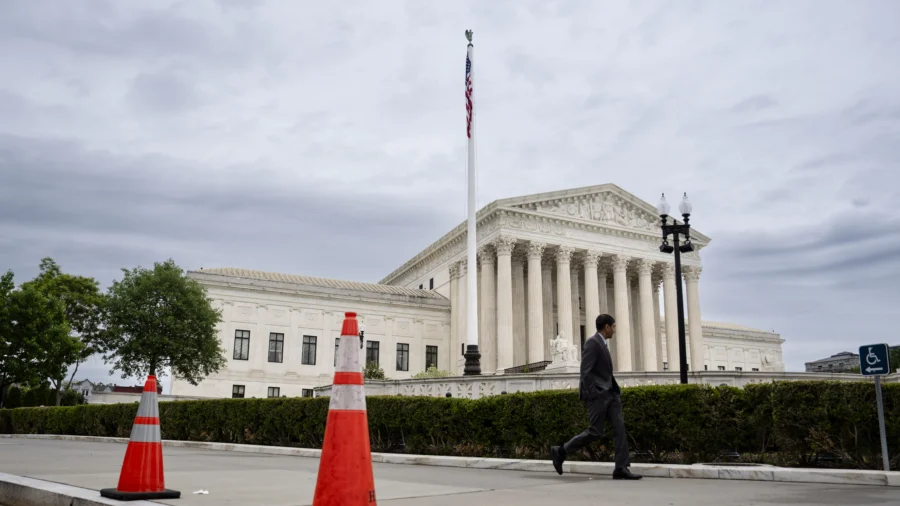
The U.S. Supreme Court in a landmark decision on April 29 reinterpreted a provision of the Voting Rights Act and struck down a majority-black congressional district in Louisiana, opening the door for more redistricting across the United States.
Ruling Impacts Key Voting Rights Act Section
The ruling was authored by Justice Samuel Alito and joined by Chief Justice John Roberts and Justices Clarence Thomas, Neil Gorsuch, Brett Kavanaugh, and Amy Coney Barrett.Alito wrote that “allowing race to play any part in government decisionmaking represents a departure from the constitutional rule that applies in almost every other context.”
He said Section 2 of the Voting Rights Act is effectively limited to instances of intentional discrimination, a very high standard.
“Only when understood this way does (Section 2) of the Voting Rights Act properly fit within Congress’s 15th Amendment enforcement power,” Alito wrote.
The 15th Amendment, a Reconstruction-era amendment of the Constitution that was ratified in 1870 following the end of the Civil War, allows Congress to pass laws ensuring that the right to vote cannot be denied “on account of race, color or previous condition of servitude.”
Louisiana Map ‘Unconstitutional’
With the decision, the high court blocked an electoral map in Louisiana that would have given the state a second majority-black congressional district.The Supreme Court’s ruling was issued amid a battle unfolding between Republican-led and Democratic-led states around the country involving the redrawing of electoral maps to change the composition of House of Representatives districts ahead of the November elections.
“That map is an unconstitutional gerrymander,” Alito wrote for the majority, adding that the Voting Rights Act doesn’t “require Louisiana to create an additional majority-minority district” and ruling that there is “no compelling interest” that justified Louisiana using race to create Fields’ district.
The U.S. Constitution, he added, “almost never permits a State to discriminate on the basis of race, and such discrimination triggers strict scrutiny.”
The decision was issued as other states have moved to implement new congressional districts ahead of the November 2026 midterm elections.
Dissenting Justice Describes Risks
In a dissent, Justice Elena Kagan warned that the majority could wind down decades of civil rights-related protections. Justices Sonia Sotomayor and Ketanji Brown Jackson joined the dissent.“That is racial vote dilution in its most classic form,” Kagan argued in the dissent. “A minority community that is cohesive in its geography and politics alike, and that faces continued adversity from racial division, is split—’cracked’ is the usual term—so that it loses all its electoral influence.”
“Members of the racial minority can still go to the polls and cast a ballot. But given the State’s racially polarized voting, they cannot hope—in the way the State’s White citizens can—to elect a person whom they think will well represent their interests.”
The majority’s ruling, she added, rendered the Voting Rights Act “all but a dead letter,” and she predicted “grave” consequences.
Kagan said the ruling means a state can “systematically dilute minority citizens’ voting power.”
Reactions Along Partisan Lines
Democratic lawmakers criticized the ruling.The 60 members of the Congressional Black Caucus, which has not admitted black Republican representatives and is made up of Democrats in its entirety, said the ruling would erode what they said are civil rights-era protections and said “racist” maps would be enacted by GOP majorities in Republican-led states.
“Republicans now have the ability to move forward with a nationwide scheme to rig congressional maps in their favor—to manufacture more districts for themselves by eliminating majority-Black districts, while stripping away the ability to challenge those racist, anti-Black maps in court,” the group said in a statement after the ruling was issued.
Fields, a member of the caucus, said that the ruling would significantly impact the district he represents but said the state map likely won’t be redrawn before the midterms.
“While the Western District has the authority to act, redrawing maps at this stage would not be prudent,” he said in a statement to local media outlets after the ruling. “Through qualifying, the voters of Louisiana have already made their decisions as it pertains to November’s ballot, and any changes to the map’s configuration would invalidate their choices.”
Republicans, meanwhile, hailed the ruling. House Speaker Mike Johnson (R-La.) told reporters on April 29 that the Supreme Court reached the “obvious conclusion” in the case and signaled the possibility of a new map being drawn soon for Louisiana.
“We’ll see what effect it has,” Johnson said. “We have, as you know, a primary coming up in about two weeks. So we’ll see if the state legislature deems it appropriate to go in and draw new maps.”
The chair of the National Republican Congressional Committee, Rep. Richard Hudson (R-N.C.) also praised the court for its decision and said that U.S. elections “should be decided by voters, not engineered through unconstitutional mandates,” according to a statement posted on X.
The Epoch Times contacted Fields’ office for comment but did not hear back by time of publication.