


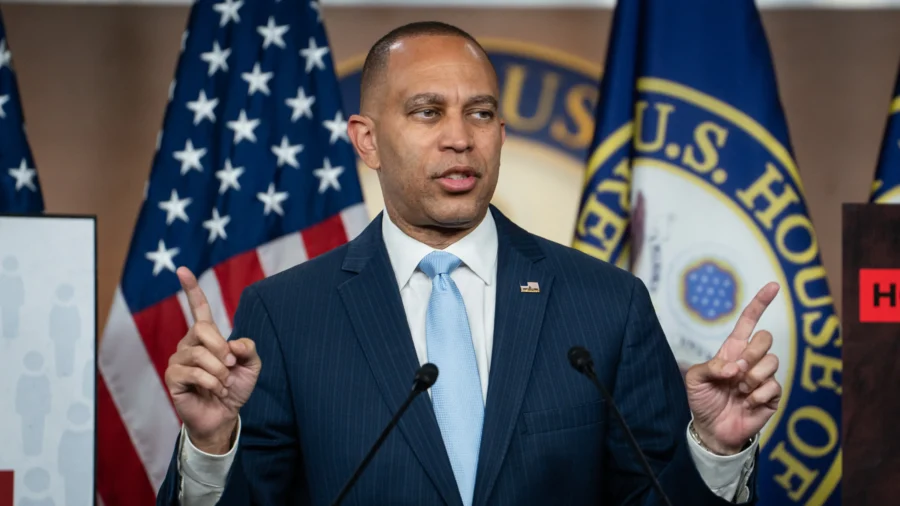
House Minority Leader Hakeem Jeffries (D-N.Y.) warned President Donald Trump on Friday not to take offensive military action against Iran without explicit authorization from Congress, amid escalating discussion of U.S. involvement in the Middle East.
Jeffries added that “Iran is a sworn enemy of the United States and can never be permitted to become a nuclear-capable power,” while also reaffirming that “Israel has a right to defend itself against escalating Iranian aggression and our commitment to Israel’s security remains ironclad.”
“Based on the fact that there’s a substantial chance of negotiations that may or may not take place with Iran in the near future, I will make my decision whether or not to go within the next two weeks,” press secretary Karoline Leavitt said on July 19, quoting the president.
Trump has been holding meetings in the Situation Room on what to do about Iran, according to Leavitt. She said the president remains focused on preventing Tehran from obtaining a nuclear weapon, and not on regime change.
“Let’s be very clear: Iran has all that it needs to achieve a nuclear weapon,” Leavitt said. “All they need is a decision from the supreme leader to do that, and it would take a couple of weeks.”
“It is the Americans who are seeking negotiations; they have sent messages multiple times, including very serious ones. But we have explicitly told them that as long as the aggression and attacks continue, there is simply no room for talk of dialogue or diplomacy,” Araghchi said.
Jeffries called for a diplomatic approach rather than military escalation.
“Aggressive diplomacy resulting in a longer and stronger agreement that permanently halts Iran’s nuclear aspirations is the most appropriate course of action at this time,” he said.
While Trump has expressed support for Israel’s campaign, he has also indicated that military involvement by the United States is not inevitable.
Congressional efforts to assert oversight have picked up steam. Sen. Tim Kaine (D-Va.) and Rep. Ro Khanna (D-Calif.) have introduced resolutions reaffirming that the president must seek congressional approval before any new military engagement.