


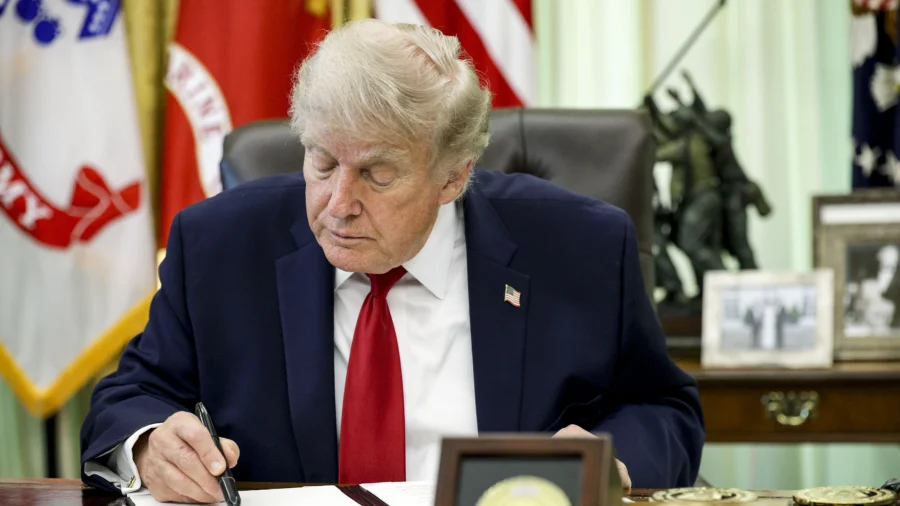
President Donald Trump invoked the Defense Production Act on July 30 to implement export restrictions on recoverable critical minerals.
The presidential memorandum gave Secretary of Commerce Howard Lutnick authority to restrict the export of old batteries and other electronic waste containing critical minerals and materials.
The July 30 directive came after Trump recently directed the Department of War to restrict waivers in 2027 for defense contractors that purchase critical minerals from certain foreign countries. The Trump administration previously noted that 70 percent of U.S. imports of rare earth minerals came from China and that the United States is fully dependent on imports for at least 15 critical minerals.
The memorandum said that recoverable critical minerals and materials are needed for national defense.
“America’s inadequate supply of CMMs [critical minerals and materials] poses an increasing risk to our national defense and security,” it said. “The United States relies heavily on imports of certain CMMs from foreign sources, and this reliance threatens serious, sustained supply chain disruptions.”
The memorandum added that the United States needed to take immediate action to secure its supply of recoverable critical minerals and materials.
The United States exports almost 33,000 metric tons (36,376 U.S. tons) of e-waste each month, according to a 2025 report published by the Basel Action Network, a Seattle-based environmental group. The e-waste documented in the report included lithium and other critical minerals and materials that could be recycled.
“This new, almost invisible tsunami of e-waste, is taking place ... padding already lucrative profit margins of the electronics recycling sector while allowing a major portion of the American public’s and corporate IT equipment to be surreptitiously exported to and processed under harmful conditions in Southeast Asia,” the Basel Action Network said.
In February, the U.S. Geological Survey released its annual Mineral Commodity Summaries. The report showed that the United States remained dependent on imports from China as a major source of 14 critical minerals, including tungsten and antimony.
“Critical minerals have become central in U.S. Government policymaking and international relations,” U.S. Geological Survey Director Ned Mamula said. “In 2025 the minerals industries contributed over $4 trillion to the U.S. economy, and clearly minerals will be the lifeblood of the 21st century global economy.”
On July 22, the U.S. Government Accountability Office said that extracting minerals from recycled batteries could reduce copper, cobalt, lithium, and nickel imports in two to three years. The office recommended that the United States develop domestic infrastructure to increase the recycling of batteries and semiconductors.
In March, Trump invoked the Defense Production Act to expand domestic mineral production capacity. The order directed the Department of War, the Department of Energy, the Department of Agriculture, and the Department of the Interior to identify potential sites for mineral production.
On July 20, Trump signed an executive order establishing restrictions for the defense industry and other manufacturers in the United States regarding waivers used to obtain critical minerals from China, Russia, Iran, and North Korea. The restrictions will take effect on Jan. 1, 2027.
The July 20 order directed the Department of War to implement regulatory action requiring critical supply chain mapping. It also encouraged defense contractors to start qualifying new domestic sources of critical minerals and materials for national security purposes.
A fact sheet released by the White House on Thursday said that the United States had a substantial amount of critical minerals and materials in products such as lithium-ion batteries and magnets. However, it warned that the United States was still heavily reliant on certain critical minerals and materials from other countries, which included sources that the White House said were at risk of long-term supply chain disruptions.
“President Trump is taking action to ensure that the United States has the industrial resources necessary to ensure our national defense and security,” the White House said.