


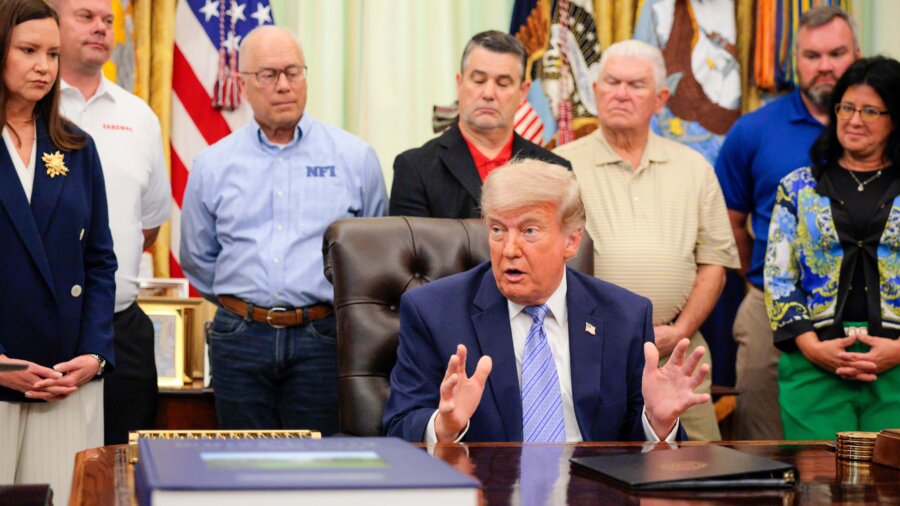
President Donald Trump said on May 21 that he would delay signing an anticipated executive order on artificial intelligence (AI) after becoming dissatisfied with its current form.
"Because I didn't like certain aspects of it, I postponed it," Trump told reporters during an Environmental Protection Agency event at the White House on May 21.
He said he did not want to do anything that would prevent the United States from leading the world, particularly China, in AI development.
"AI, it's causing tremendous good,” Trump said. “And it's also bringing in a lot of jobs, tremendous numbers of jobs. I really thought [the executive order] could have been a blocker, and I want to make sure that it's not."
When asked during a follow-up question whether he had discussed AI safeguards during his summit last week with Chinese leader Xi Jinping, Trump confirmed that the two had had a conversation about the topic.
"He acknowledges how well we're doing,” he said. “We're doing well. He said it was the two of us—the two countries are fighting for [AI]. Other countries are way behind, way, way behind. They're fighting for it. They want to, everybody wants it, but they're way behind.”
Trump noted that he postponed the executive order signing ceremony because he “didn't like” what he was seeing.
The White House has not yet publicly confirmed what was inside the draft version of the executive order on AI that Trump is expected to sign soon.
The federal government has recently been grappling with the risk of frontier AI models.
The Trump administration had previously moved to ban Anthropic from doing business with the federal government after the company refused to grant the Pentagon unrestricted access to its Claude models, stating that it was concerned that they would be used for mass domestic surveillance or fully autonomous weapons, which the Pentagon denies.
Despite the ban, Anthropic co-founder Jack Clark said last month that he had been in talks with the Trump administration over Claude Mythos Preview.