


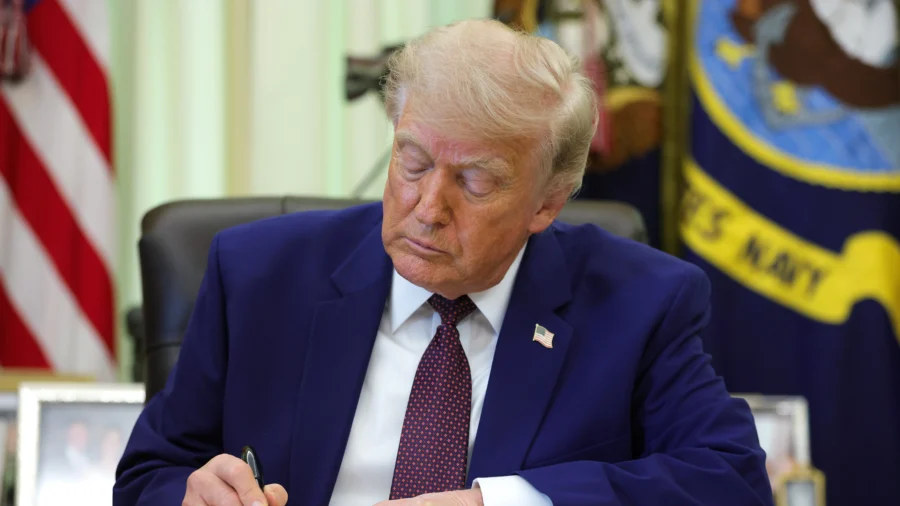
President Donald Trump reclassified about 8,000 federal positions on Jan. 3, moving them into a new employment category with fewer civil service protections.
By signing the executive order “Implementing Schedule Policy/Career in the Excepted Service,” Trump made it easier for employees in certain senior policy-making roles to be removed for poor performance.
The roles will remain “career” positions, and the non-partisan hiring processes, competitive status, and other aspects of the jobs will not change, according to the White House.
Terminations will be made without respect to political affiliation, the administration said.
The “schedule policy/career” jobs will be at-will positions, meaning agencies can remove those employees for poor performance, misconduct, corruption, or subversion of presidential directives without lengthy procedures.
According to the White House, 97 percent of the reclassified positions are senior-level positions. These are the highest-ranking jobs within agencies, outside of the senior executive service.
The roles include agency positions, such as directors, deputy directors, chiefs of staff, senior advisors, policy analysts, public affairs, legislative affairs leaders, and others who are hired with money from federal grants.
“Personnel rules make removing federal employees for any reason exceedingly difficult,” the White House said. “Consequently, employees with significant policy-making responsibilities can stay in their jobs for years even if they perform poorly, engage in misconduct, or are unwilling to advance Presidential policy across administrations, making their agencies less capable of delivering for the American people.”
Removing an employee can take years. When polled, many senior federal employees in Washington, D.C., said they would ignore a lawful order from Trump that they considered bad policy, the White House noted in the fact sheet.
During the first Trump administration, career employees refused to help on policy matters, such as prosecuting racial discrimination in higher education, according to the fact sheet.
During his presidential campaign in 2024, Trump promised to identify and address federal waste and inefficiency by shrinking the government workforce.
Over 348,000 employees have quit, retired, or been laid off in 2025—an 81 percent increase from 2024. And, nearly 117,000 others started working for the federal government—a 56 percent decrease, according to Pew.
The largest cuts were to the Education Department, which shrank nearly 43 percent, and USAID, which lost 92 percent of employees and was nearly eliminated, the research center said.