



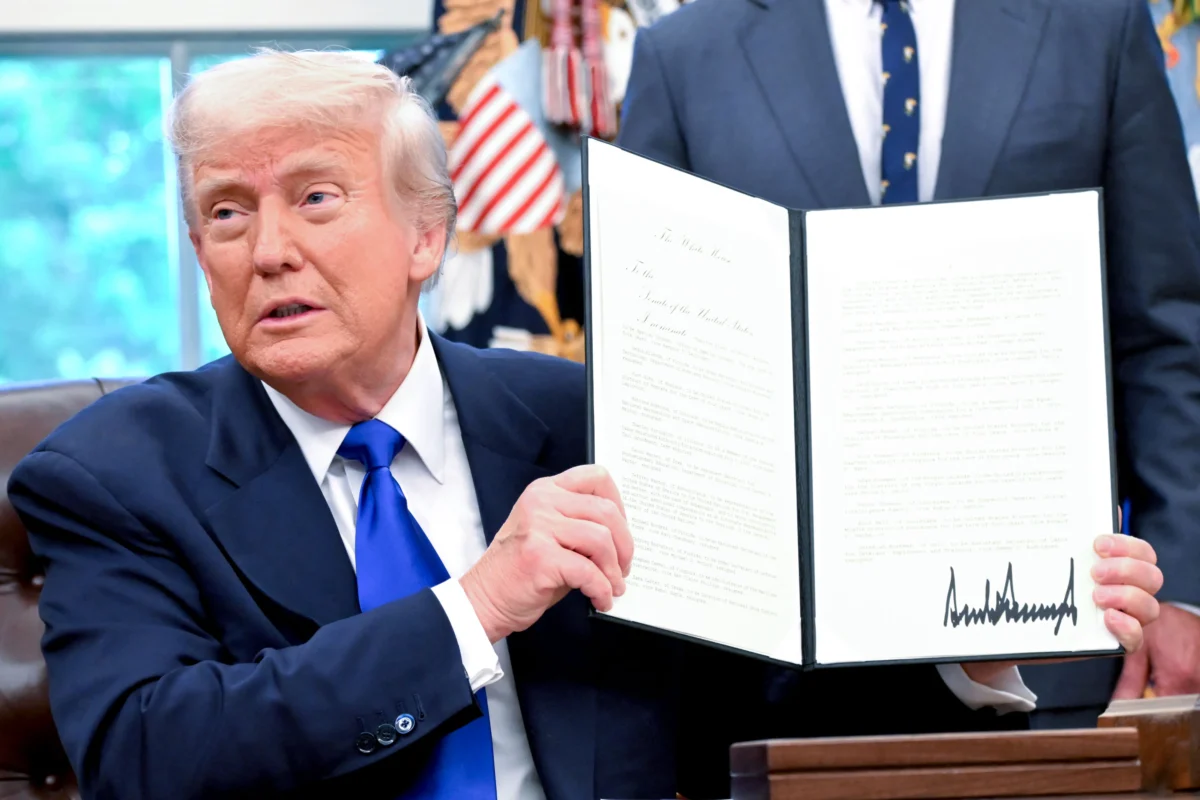
President Donald Trump signed an executive order on Aug. 7, opening the $9 trillion retirement market to cryptocurrencies and other alternative assets, White House officials said.
Typical 401(k) plans enable individuals to invest in a variety of assets, including stocks and bonds. The current administration is poised to introduce changes to conventional retirement accounts.
Under a new executive order, the secretary of the Department of Labor will review fiduciary guidelines governing private market investments—such as private equity and alternative assets—within 401(k) and other defined contribution plans covered by the Employee Retirement Income Security Act of 1974, which sets minimum standards for most retirement plans.
In conducting this review, the secretary will collaborate with the treasury secretary, the Securities and Exchange Commission, and other federal regulators to evaluate potential policy changes.
Trump aims to grant millions of Americans greater access to investment options and financial opportunities, the White House official said.
Alternative assets, such as cryptocurrencies, private equity, and real estate, could potentially reshape how workers’ nest eggs are managed.
The directive would mark a significant departure from current policy, which excludes private market assets from 401(k) plans. It also emulates similar efforts employed in the final months of Trump’s first term in the White House.
At the time, Trump supported changes to consider private market investments in retirement plans, which private equity firms viewed as a green light to establish retirement-related products.
The Department of Labor determined that private equity could be included in investment choices, but not as a stand-alone option.
Response to Private Equity
Companies have been preparing for this announcement."By thoughtfully integrating private assets into target date solutions, participants could see about a 15 [percent] boost in their 401(k) savings over 40 years," the Wall Street firm said in a statement.
Critics, including Sen. Elizabeth Warren (D-Mass.), have pushed back against this proposal, pointing to high fees and a lack of transparency in private equity.
"Given the sector’s weak investor protections, its lack of transparency, expensive management fees, and unsubstantiated claims of high returns, we are seeking information on how your company will ensure the safety of the billions of dollars of retirement savings it safeguards as it implements this program," Warren said.
Empower CEO Ed Murphy responded, likening the current situation to the creation of 401(k) accounts decades ago.
Supporting Cryptocurrency
Trump’s latest executive action further supports his administration’s crypto-friendly stance.Trump recently signed two key pieces of legislation: the GENIUS Act and the Clarity Act.
The former establishes a federal framework for stablecoins—digital assets pegged to U.S. assets such as the U.S. dollar and treasury securities—and the latter reduces regulatory ambiguity by clearly dividing cryptocurrency regulatory responsibilities between the Securities and Exchange Commission and the Commodity Futures Trading Commission.
"By implementing these recommendations, policymakers can ensure that the United States leads the blockchain revolution and ushers in the Golden Age of Crypto," the White House said ahead of the report's release on July 30.
Bitcoin, meanwhile, surged by more than 1 percent following the president’s July order, topping $117,000. Ethereum also climbed by about 4 percent to higher than $3,800.
Private equity stocks struggled during the Aug. 7 trading session. Share prices of Apollo Global Management (APO) and Blackstone (BX) fell by 4 percent and 1 percent, respectively. Both are traded on the New York Stock Exchange.
Financial institutions are increasingly placing bitcoin in their 401(k)s. Fidelity, for example, in 2022 became the first retirement plan provider to offer this option to clients.