


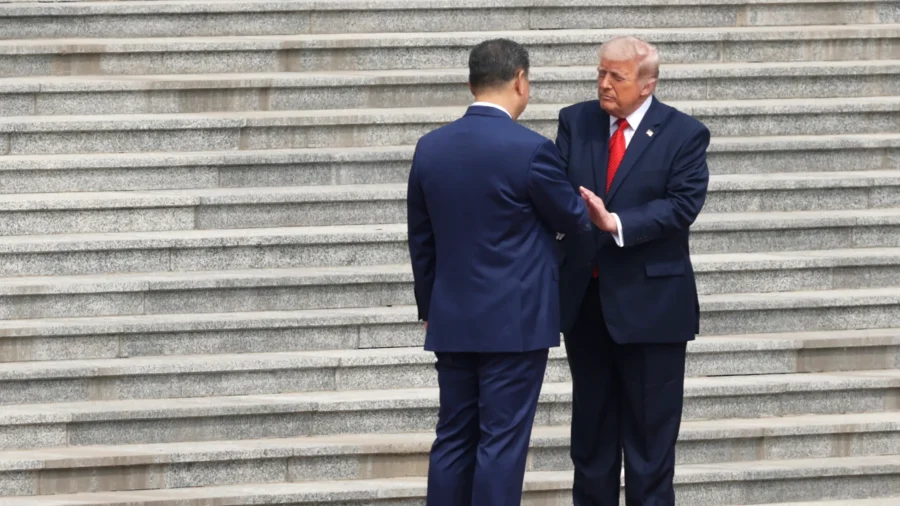
President Donald Trump will meet Chinese leader Xi Jinping for the second day of their summit on May 15, with Iran and Taiwan expected to dominate the agenda.
The war in Iran—approaching its 12th week—has upended international energy markets. Global oil prices are above $100 per barrel, and the costs of various capital and consumer goods have surged.
In an interview with Fox News host Sean Hannity on May 14, the president said the Chinese regime does not intend to stop buying energy from Iran.
“[Xi] said he's not going to give military equipment [to Iran]. That's a big statement,” Trump told Hannity. “But at the same time, he said they buy a lot of their oil there, and they'd like to keep doing that.”
The Trump administration has tried to convince the Chinese regime that helping resolve Middle East tensions is in its best interests.
China is the main buyer of Iranian crude. In 2024, about 10 percent of its imports came from Iran, and around 90 percent of Tehran's crude oil exports are directed to China, according to the U.S. Energy Information Administration.
Reports suggest that prior to the war, almost a fifth of Beijing’s total oil imports were from Iran, averaging as much as 1.5 million barrels per day.
Earlier this month, Tehran said it would impose a 10 percent toll on all ships traversing the Strait of Hormuz. Officials also launched a new office to facilitate the safe passage of commercial vessels through the area.
"[Xi] didn't like the fact that they're charging tolls," Trump said.
The narrow waterway, located between Iran and the Arabian Peninsula, is a global chokepoint for a basket of oil, liquefied natural gas, petrochemicals, fertilizer, and other commodities.
Regardless of China’s stance on the Iranian conflict, a White House readout states that “both countries agreed that Iran can never have a nuclear weapon."
But the world's largest petroleum importer plans to use its influence to help reopen the Strait of Hormuz, says Treasury Secretary Scott Bessent.
“It’s very much in their interest to get the strait reopened,” Bessent told CNBC’s "Squawk Box" on May 14. “I think they will be working behind the scenes to the extent anyone has any say over the Iranian leadership.
“China has a much bigger interest in reopening the strait than the U.S. does.”
Taiwan in Focus
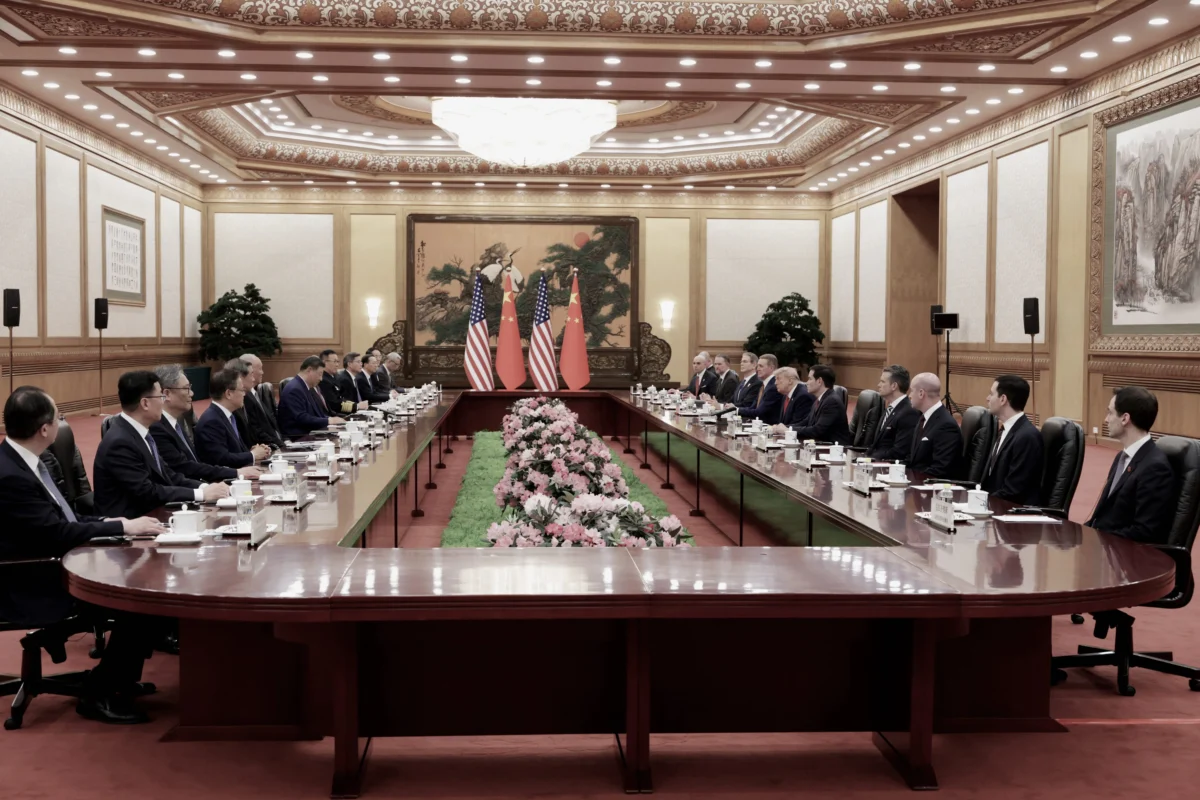
At the start of the U.S.–China summit, Xi told Trump that disagreement over Taiwan could harm trade negotiations.“The U.S. side must exercise extra caution in handling the Taiwan question,” a statement released by China’s Ministry of Foreign Affairs reads.
“If it is handled properly, the bilateral relationship will enjoy overall stability. Otherwise, the two countries will have clashes and even conflicts, putting the entire relationship in great jeopardy.”
Secretary of State Marco Rubio confirmed that Xi raised the issue, but arms sales were not a primary topic in Thursday’s discussion.
“U.S. policy on the issue of Taiwan is unchanged as of today, and as of the meeting that we had here today,” he told NBC News.
Rubio said that whenever the topic of Taiwan comes up, the United States makes clear that any effort to alter the island’s status through military force “would be problematic.” He stressed that Washington’s approach has remained steady “across multiple presidential administrations.”
But several senators urged the president to make clear to China that U.S. support for Taiwan "is not up for negotiation."
"Just as Taiwan’s leaders demonstrated unity in support of their people’s defense, so too must we move ahead with pending U.S. arms sales vital to our own national interests," they wrote in a May 8 letter.
"For the sake of all Americans, the United States must continue to help Taiwan defend itself."
US–China Trade
Despite Washington and Beijing being at odds over trade for the past year, Trump and Xi have attempted to improve relations.Trump said in the Fox News interview that Xi agreed to purchase Boeing airplanes.
"One thing he agreed to today, he’s going to order 200 jets. That’s a big thing—Boeings," the president stated. "That's a lot of jobs—that's a lot. Boeing wanted 150; he got 200."
Trump stopped short of identifying which specific aircraft Beijing would buy from the U.S. company.
There had been speculation that the summit would net positive results for the aerospace manufacturer.
In an earnings call on April 22, Boeing CEO Kelly Ortberg told analysts that the Trump–Xi meeting could be a "meaningful opportunity" for the company.
“I’m not going to give you the number of airplanes, but it’s a big number,” Ortberg, who joined Trump and other top U.S. executives on the trip, said in the conference call.
Bessent also revealed that he is looking into a board of investment with China to bolster the economic relationship between the two countries. The purpose, he told CNBC, would be two-fold: address security concerns and "decide up front what are the nonstrategic, nonsensitive areas where it would be possible for the Chinese to invest."
“There are plenty of things that the Chinese could invest in in the U.S.,” Bessent said. “And we’re trying to push the same thing in the U.S. President Trump today told Xi Jinping that he wants to open up China. And China should open up.”
Another key area that the two nations will concentrate on is artificial intelligence (AI).
The United States is the world's AI leader, Bessent told the business network.
He said the two leading AI powers will begin formal discussions and establish a framework for moving forward on shared AI best practices, with the goal of preventing nonstate actors from gaining access to advanced models.
“The reason we are able to have wholesome discussions with the Chinese on AI is because we are in the lead,” Bessent said. “I do not think we would be having the same discussions if they were this far ahead of us."