

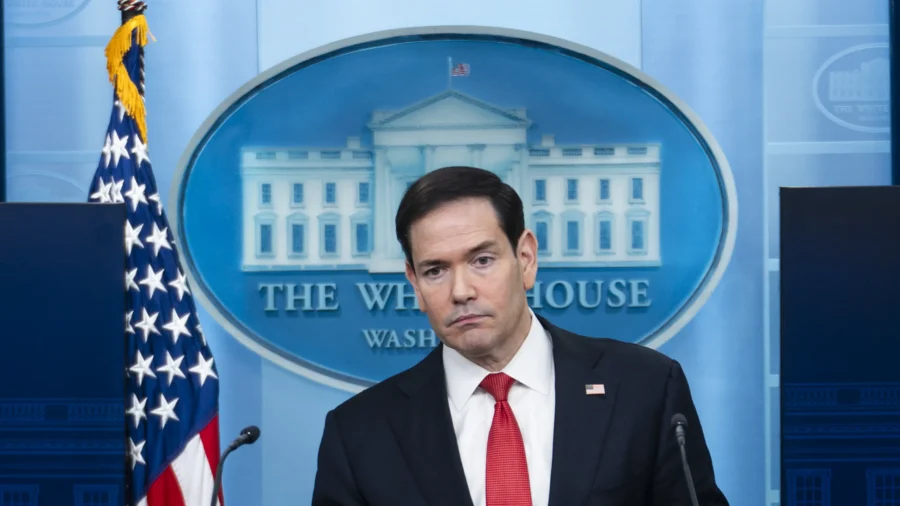
WASHINGTON—U.S. Secretary of State Marco Rubio announced on May 18 new sanctions against several Cuban government agencies and senior officials to address “repression in Cuba and threats to U.S. national security.”
“I designated 11 Cuban regime elites and three government organizations, including government officials and military figures associated with Cuba’s security apparatus, many of whom are responsible for or have been involved in repressing the Cuban people,” Rubio said in a statement.
Among the government agencies sanctioned are the Ministry of Interior, which is Cuba’s main internal security agency responsible for police, internal security forces, intelligence agencies, and prisons; the National Revolutionary Police, Cuba’s police force accused of suppressing protests and operating mobile prisons; and the Directorate of Intelligence of Cuba, the country’s main intelligence agency.
The sanctions also target senior Cuban government officials, including Eddy Manuel Sierra Arias, head of the national police; Oscar Alejandro Callejas Valcarce, a senior Interior Ministry official; and Rosabel Gamon Verde, Cuba’s justice minister.
The United States accused the sanctioned entities and individuals of contributing to the suffering of the Cuban people and the decline of the Cuban economy and of allowing foreign countries to exploit Cuba for intelligence, military, and terrorist activities.
Other senior officials designated include Joaquín Quintas Solá, the deputy minister of Cuba’s Revolutionary Armed Forces; Juan Esteban Lazo Hernández, president of Cuba’s National Assembly; Vicente de la O Levy, minister of energy and mines; and Mayra Arevich Marín, minister of communications.
U.S. sanctions also targeted military and communist party leaders, including Jose Miguel Gomez del Vallin, Raul Villar Kessell, Roberto Tomás Morales Ojeda, and Eugenio Armando Rabilero Aguilera.
Under these sanctions, all property and financial interests of designated individuals and entities within U.S. jurisdiction are blocked. U.S. citizens and businesses may not conduct transactions with them unless specifically authorized by the Treasury Department’s Office of Foreign Assets Control.
The State Department also warned that foreign banks, businesses, and individuals who engage in transactions with sanctioned Cuban officials or operate in Cuba’s defense, energy, mining, financial, or security sectors may also be subject to sanctions.
“Today’s designations further restrict the Cuban regime’s ability to suppress the will of the Cuban people,” Rubio said. “Additional sanctions actions can be expected in the following days and weeks.”
His comments came after Axios reported on May 17, citing classified intelligence sources, that Cuba had obtained more than 300 military drones that could be used to attack the U.S. naval base at Guantanamo Bay, American military ships, or even Florida.
Cuban Foreign Minister Bruno Rodríguez has accused Washington of fabricating a “fraudulent case” to justify additional economic sanctions and potential military action.
“Cuba neither threatens nor desires war,” Rodríguez wrote on X on May 17.
The Trump administration has not confirmed the intelligence report, but the State Department issued a forceful statement in response to Rodríguez.
“President Trump will always act to protect Americans, our interests and our homeland from any threats, and has taken historic action to rid our backyard of uncontrolled migration, dangerous narco trafficking, organized crime, and hostile foreign military presence,” the State Department told The Epoch Times in a statement.
“Cuba, a failed Communist state which has long hosted hostile foreign military, intelligence and terror groups, presents a significant threat to our national security that President Trump will not allow to devolve into a greater crisis to the safety and security of Americans.”