


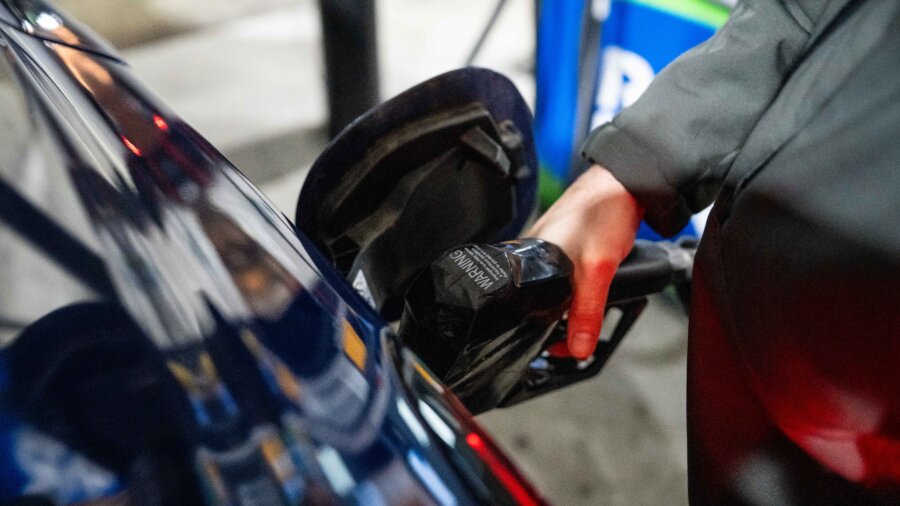
U.S. motorists are expected to see the lowest gas prices since 2020, according to a new outlook released by GasBuddy on Jan. 6.
But while drivers will experience less pain at the pump, they will continue to see bouts of volatility driven by refinery maintenance, seasonal demand, weather, and persistent geopolitical challenges.
Gas prices will likely peak in the spring, reaching the low $3.20s as the transition to summer gasoline begins. They will then start to fall after June, "with December forecast to average $2.83."
The national average for a gallon of diesel is projected to be $3.55, down from last year's $3.62.
"The world has spent years recovering from the economic whiplash of the pandemic and the shock of Russia’s invasion of Ukraine, but the situation has been improving quietly since 2022,” Patrick De Haan, head of petroleum analysis at GasBuddy, said in a news release.
Industry experts have also noted that the previous administration's regulatory agenda for the energy sector added to drivers' inflationary pressures.
Central bank policy tightening and new refining capacity helped ease fuel prices, "and 2026 keeps that momentum going," De Haan continued.
"It’s not a return to ultra-cheap fuel, but for the first time in a long time, the wind is clearly behind drivers’ backs," he said. "If the market avoids major surprises, sustained averages below $3 per gallon could become commonplace in the year ahead."
California, however, continues to skew the national average as prices remain firmly above $4 a gallon.
What It Feels Like at the Pump
Despite declining crude oil prices, the cost of a gallon of gas trended sideways throughout much of 2025. It was not until November that national gas prices began to decline sharply, falling below $3 for the first time since May 2021.But more than two dozen states now have prices under the national average, led by Oklahoma, where gasoline is $2.238 per gallon—the lowest in the nation.
The trend will continue for the foreseeable future as market watchers anticipate low oil prices.
With the situation in Venezuela still unfolding, it remains uncertain how much the regime change will influence global energy markets.
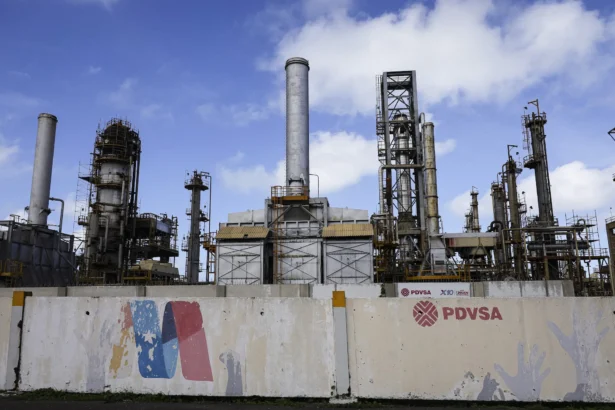
"I think we can do it in less time than that, but it’ll be a lot of money," Trump said.
"A tremendous amount of money will have to be spent, and the oil companies will spend it, and then they’ll get reimbursed by us or through revenue."
By having access to Venezuela's oil, which is primarily heavy crude that requires intensive refining, it will be good for the United States "because it keeps the price of oil down," the president added.
Whether American oil companies will be incentivized to keep producing crude at low prices remains to be seen.
Still, shares of American oil companies rocketed on Jan. 5, only to pull back the next day.
Shares of Chevron and Exxon Mobil declined 3 percent and 1 percent, respectively. Shell's stock slipped 0.4 percent, while ConocoPhillips was flat.
For now, the Venezuelan conflict will have little effect on global oil prices as financial markets monitor the situation, says Jeffrey Roach, chief economist at LPL Financial.
"Venezuela currently produces roughly 1% of the world’s crude, and its exports have been constrained for years by sanctions, underinvestment, and infrastructure challenges," Roach said in a note emailed to The Epoch Times.
"With global production exceeding 100 million barrels per day and major suppliers like the United States, Saudi Arabia, and Russia dominating the market, any disruption in Venezuelan output is unlikely to create significant supply shortages."
Crude oil prices were little changed on Jan. 6.
WTI futures dipped about 0.3 percent to $58.15 a barrel on the New York Mercantile Exchange. Brent, the international benchmark for oil prices, slid nearly 0.2 percent to $61.66 a barrel on London's ICE Futures exchange.