


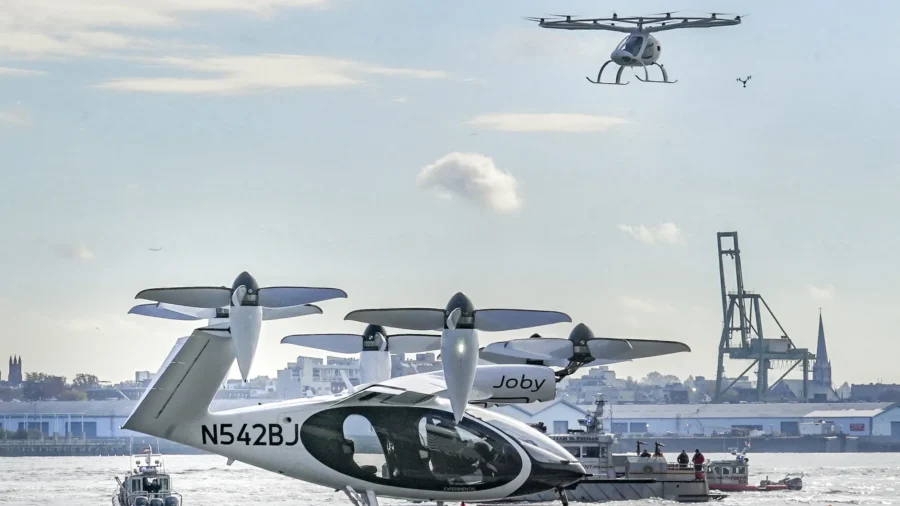
Eight pilot projects across 26 states will test next-generation aircraft—including electric vertical takeoff and landing vehicles, cargo drones, and medical transport systems—the U.S. Department of Transportation (DOT) and the Federal Aviation Administration (FAA) announced Monday.
The projects are part of the Advanced Air Mobility and Electric Vertical Takeoff and Landing Integration Pilot Program, a federal effort to accelerate the integration of emerging aircraft technologies into U.S. airspace.
The FAA said the testing will create one of the largest real-world environments for evaluating next-generation aircraft. “The American public will start to see operations begin under this program by summer 2026,” the agency said.
Electric vertical takeoff and landing (eVTOL) aircraft are battery-powered aircraft designed for urban and regional travel. Using electric motors, they can take off, hover, and land vertically without runways.
New York and New England
A project led by the Port Authority of New York and New Jersey will test passenger air taxi operations in New York City, including flights from the Manhattan heliport.Texas
The Texas Department of Transportation will oversee testing to develop regional passenger flight networks connecting Dallas, Austin, and San Antonio, with potential expansion to Houston.Pacific Northwest, Rocky Mountains, and Oklahoma
A multistate project led by the Utah Department of Transportation will test next-generation aircraft concepts in the Pacific Northwest, Rocky Mountain region, and parts of the Plains, including Oklahoma.Multistate Regional Flight Network
Another initiative, led by the Pennsylvania Department of Transportation in partnership with the National Association of State Aviation Officials, will operate across 13 states.Louisiana and the Gulf Coast
A Louisiana-based project will test aircraft designed to transport cargo and personnel to offshore energy sites “to enable flights over the high sea.”Florida
The Florida Department of Transportation will lead a statewide effort testing cargo delivery, passenger transportation, automation, and emergency medical response.North Carolina and Virginia
The North Carolina Department of Transportation will oversee testing focused on medical transport and regional passenger service throughout North Carolina, with autonomous flight operations extending into Virginia.New Mexico
The city of Albuquerque will host a project to advance autonomous flight operations in partnership with Reliable Robotics.Future of Flight and Safety
Transportation Secretary Sean Duffy said the program will help advance aviation innovation while generating operational data for regulators.“Thanks to President Trump, the future of aviation is here—and it’s going to dramatically improve how people and products move,” Duffy said.
“Congratulations to the great American innovators behind each of these exciting pilot programs. Working together, we will ensure America leads the way in safely leveraging next-gen aircraft to radically redefine personal travel, regional transportation, cargo logistics, emergency medicine, and so much more,” he said.
The pilot program stems from an executive order by President Donald Trump to expand drone and advanced air mobility technology in the United States.
FAA Deputy Administrator Chris Rocheleau said the testing will guide regulators as they develop future aviation standards.
“These partnerships will help us better understand how to safely and efficiently integrate these aircraft into the National Airspace System,” Rocheleau said. “The program will provide valuable operational experience that will inform the standards needed to enable safe Advanced Air Mobility operations.”
Participating companies across the pilot projects include Archer Aviation, BETA Technologies, Joby Aviation, Electra, Wisk, Ampaire, Elroy Air, and Reliable Robotics.