


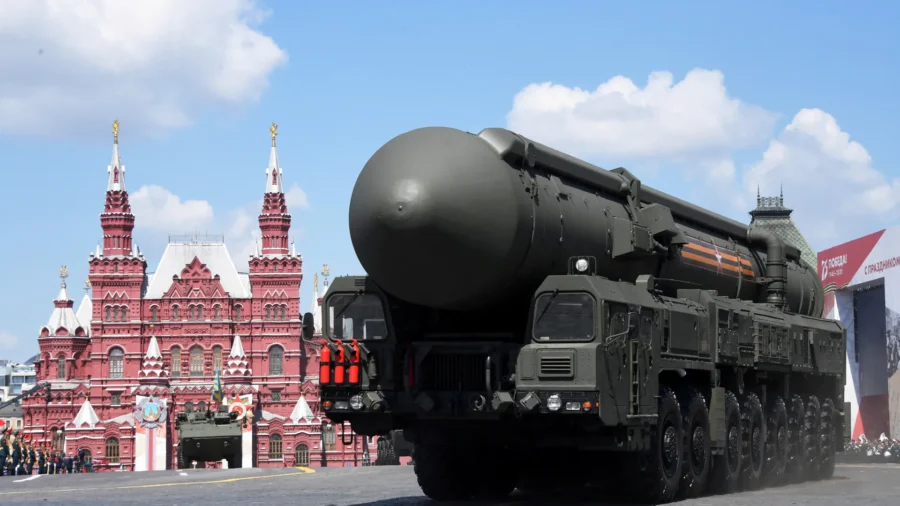
The last remaining nuclear arms control treaty between the United States and Russia expired on Feb. 5, ending legally binding limits on the world’s two largest nuclear arsenals for the first time in decades.
The New Strategic Arms Reduction Treaty, known as New START, entered into force on Feb. 5, 2011, and was extended for five years in February 2021.
The Russian Ministry of Foreign Affairs said in a Feb. 4 statement that in the absence of a formal response from Washington, Moscow would “proceed from the understanding that the parties to New START are no longer bound by any obligations or reciprocal declarations in the context of the Treaty, including its central provisions, and are, in principle, free to choose their subsequent steps.”
The ministry said that Moscow “intends to act responsibly” in shaping its strategic offensive arms policy, which it will in part base on the analysis of the U.S. military policy.
'Grave Moment'
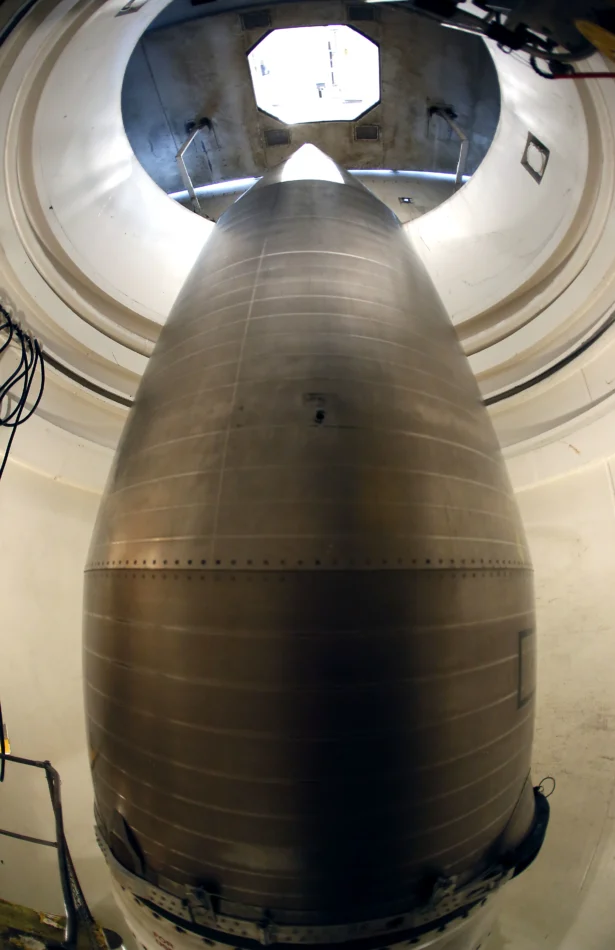
Together, the United States and Russia possess about 86 percent of the world’s nuclear weapons, the Federation of American Scientists (FAS) said in a 2025 report.Russia has about 5,459 nuclear warheads, and the United States has about 5,177, including both active warheads and retired weapons awaiting dismantlement, according to FAS.
U.N. Secretary-General António Guterres said in a Feb. 4 statement that the expiration of New START marked a “grave moment” for international peace and security.
“For the first time in more than half a century, we face a world without any binding limits on the strategic nuclear arsenals” of the two countries, he said.
He also said that the collapse of the system of restraint comes as geopolitical tensions are rising and the risk of nuclear weapon use is “the highest in decades.”
“The world now looks to the Russian Federation and the United States to translate words into action,” Guterres said, urging both sides to return to negotiations “without delay.”
Verification was central to New START. The treaty required on-site inspections and regular exchanges of data on nuclear forces to reduce mistrust and prevent miscalculation.
In February 2023, Russia suspended its participation in the treaty’s verification regime. Moscow said at the time it would continue to observe limits on deployed warheads and delivery systems, but without inspections or data sharing.
The United States has described the suspension as legally invalid. Washington responded by withholding treaty data and blocking Russian inspections.
Beijing's Reaction
Both Washington and Moscow have raised the issue of other nuclear-armed states.Trump has said future talks should include China, whose nuclear arsenal is much smaller, consisting of about 600 nuclear warheads, according to FAS.
Kremlin spokesperson Dmitry Peskov said in September 2025 that the arsenals of the UK and France will ultimately have to be included in negotiations.
"Naturally, we have to start talks at the bilateral level. New START is after all a bilateral document," Peskov told Russian state news agency TASS at the time. "But in the long term, you cannot remain abstract with these arsenals. All the more so that these arsenals are a component of the overall problem of global European security and strategic stability."
The UK has 225 nuclear warheads, and France has 290, according to FAS.
Chinese Ministry of Foreign Affairs spokesperson Lin Jian said on Feb. 5 that Beijing “regrets” the expiration of the START treaty and called on the United States to resume dialogue with Russia.
The ministry also reiterated that it adheres strictly to a self‑defense nuclear strategy.
“China’s nuclear forces are not on the same level as those of the United States and Russia, and China will not participate in disarmament negotiations at this stage,” Lin said.