


It includes a minimum of $250 billion in direct investment from Taiwanese tech enterprises in chips, energy, and artificial intelligence innovation in the United States, as well as credit guarantees by the Taiwanese government for another $250 billion in other Taiwanese investments to expand the chip supply chain in the United States.
Taiwan will also see U.S. investment in its own tech sectors and will benefit from tariff rates capped at 15 percent, down from 20 percent, and certain tariff exemptions as part of the deal.
The zero percent tariffs will apply to generic pharmaceuticals and their generic ingredients, aircraft components, unavailable natural resources, and certain amounts of Taiwanese semiconductors imported by producers that are building in the United States. Taiwanese chips may otherwise be subject to tariffs of 100 percent, according to Commerce Secretary Howard Lutnick.
The deal was signed by the American Institute in Taiwan and the Taipei Economic and Cultural Representative Office in the United States.
It is part of the Commerce Department’s “whole-of-government effort to revitalize semiconductor manufacturing” in the United States, which stands around 10 percent today, with great reliance on East Asian manufacturing, according to the department.
He said the $250 billion commitment from major Taiwanese companies and the matching investment from the Taiwanese government will help bring the entire semiconductor supply chain to the United States.
“We’re going to bring it all over so we become self-sufficient in the capacity of building semiconductors,” he said.
Lutnick said the United States has already given Taiwan a $100 billion credit in the deal because TSMC made an equivalent investment in the United States in 2025, but he expects a “huge, bigger” investment from the company that could see it “possibly doubling in size in America.”
He said the deal will result in wide-ranging investments beyond that because of the sprawling nature of the supply chain.
“All those bits and parts, they have to come here, so we’re going to have hundreds of companies come here. We’re going to build giant semiconductor industrial parks in America, and we’re going to bring semiconductors home to America,” he said.
Lutnick added that Taiwan wants to “keep our president happy,” given the threats posed to the democratically self-governed island from China on the other side of the strait.
“We need semiconductors. For our national security, we need them built in America. We can’t rely on a country that’s 9,000 miles away from us to deliver us these kind of fundamental national security products,” he said.
'Indispensable Force for Good'
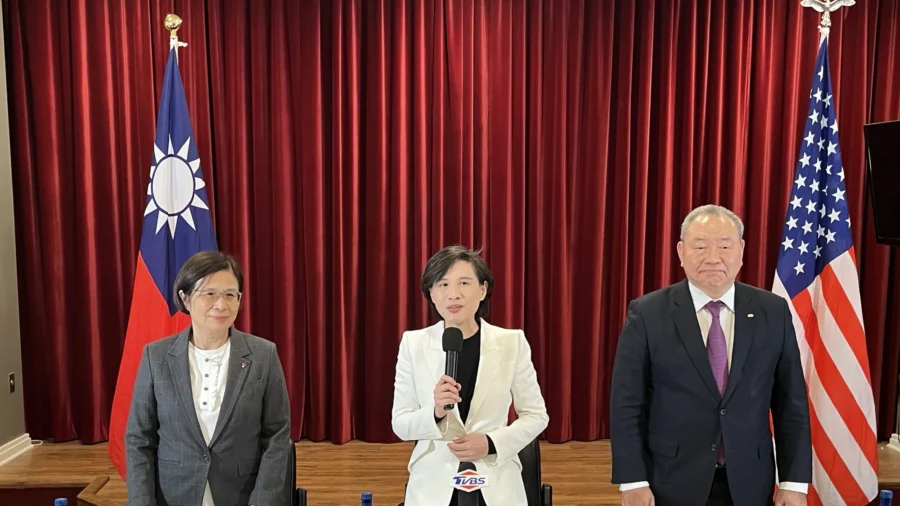
Three Taiwanese officials, Vice Premier Cheng Li-chiun, chief trade negotiator Yang Jen-ni, and Taiwan's representative to the United States, Alexander Yui, held a Jan. 15 news conference to explain the trade agreement.According to Cheng, the new 15 percent tariff will be applied directly rather than added to current most-favored nation rates, meaning Taiwan will be subject to the same tariffs as Japan, South Korea, and the European Union.
The agreement also grants Taiwan’s semiconductors and related export products the most preferential treatment under Section 232 of the U.S. Trade Expansion Act, Cheng said.
The trade deal has removed “future uncertainties” for Taiwan’s high-tech sector, specifically the semiconductor industry, Cheng added.
“In this round of negotiations, we promoted two-way high-tech investment between Taiwan and the United States, and we hope that in the future both sides can become close AI strategic partners,” Cheng said in Mandarin, according to a translation.
Cheng characterized the deal as a win-win situation, achieving strategic objectives for both sides.
“We believe this supply-chain cooperation is not 'move,' but 'build.' We expand our footprint in the U.S. and support the U.S. in building local supply chains, but even more so, it is an extension and expansion of Taiwan's technology industry,” Cheng said.
The trade agreement has not been officially signed, Cheng added, saying she expects that to be completed in the coming weeks.
“Taiwan is the first country in the world to receive relatively comprehensive and most favourable treatment regarding the U.S. tariffs imposed under Section 232,” Lai added.
Lai noted that the agreement also benefits Taiwanese companies in certain non-tech sectors, as they now operate on a “more level playing field,” whereas Japan and South Korea previously held an advantage due to their free trade or quasi-free trade agreements with the United States.
“Although Taiwan’s territory is small, we are agile and innovative, and an indispensable force for good within the global supply chain,” Hsiao said.