


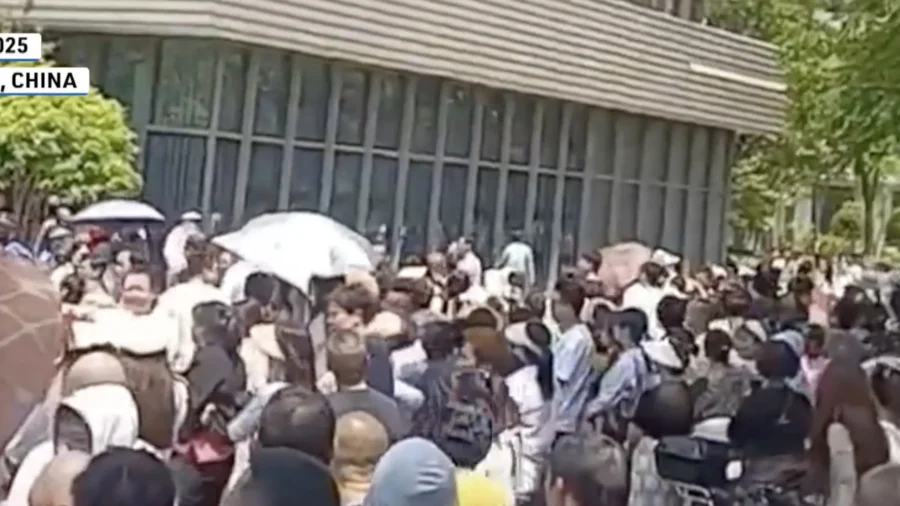
As the U.S.–China trade war persists and the Chinese economy continues to slow, protests over unpaid wages and labor strikes across China highlight mounting economic pressure and growing social unrest.
Social media accounts in China posted videos in recent weeks showing workers across the country demanding unpaid wages, with the disputes escalating into larger protests.
A Sengled employee confirmed the protest in a telephone interview with The Epoch Times on April 30. “Over a thousand of us went to the town hall to protest,” the worker said. “Employees’ wages haven’t been paid for half a year.”
“Over a dozen people were arrested,” he said. "The company owes wages to over 1,000 full-time workers. We are all entitled to full benefits—pensions, retirement funds, unemployment insurance. The amount they owe is huge, but they haven’t given us any explanation."
The worker said that the factory owner owes the government a great deal of money and the “factory should’ve shut down long ago.”
“I’m also a victim,” Mr. Feng said. “We don’t know when we’ll get paid,” reported RFA.
In addition to Sengled, recent uploads to the Chinese YouTube channel “Yesterday” and to post on X reveal a surge of videos showing workers across China demanding back pay around the Labor Day holiday.
In south central China, hundreds of workers at Guangxin Sporting Goods in Daoxian County, Hunan Province, went on strike to protest the factory’s closure—without worker compensation—on April 24.
Employees accused the company of failing to pay social insurance for an extended period, and of laying off more than 100 female workers over the age of 50 under the pretext of their reaching retirement age. The workers say the redundancies occurred without the company offering severance pay or assistance with retirement procedures since September 2024.
In western China, workers at Leader-Tech Electronics in Suining, Sichuan, went on strike on April 27 to protest long-overdue wages and unpaid social insurance. The company has reportedly not paid its share of social security contributions since June 2023 and has failed to pay employee wages this year. This is not the first instance of delayed payments, and by the end of April, workers had still not received their pay.
Beijing Facing Multiple Challenges Amid US–China Tariff War
While China’s economy faces mounting internal pressures, the escalating U.S.-China trade war is further intensifying the challenges faced by Chinese businesses and workers alike.On April 25, Chinese Communist Party (CCP) leader Xi Jinping led a meeting addressing “Four Stabilities” that needed to be secured amid rising external pressures: jobs, businesses, markets, and public confidence.
Stability centers on maintaining the current domestic socioeconomic order and Communist Party control, while the latter reflects an ongoing narrative of “great power competition” in foreign affairs.
Sun said he questions the effectiveness of the CCP’s continued reliance on tightening ideological control and guiding public opinion to achieve short-term socioeconomic stability.
He noted that while China’s underlying socioeconomic issues remain unresolved, the CCP’s heavy-handed controls are creating unintended side effects. With weak consumer spending, high youth unemployment, and escalating local debt risks, economic pressure on the regime continues to intensify, with public confidence reaching new lows.