


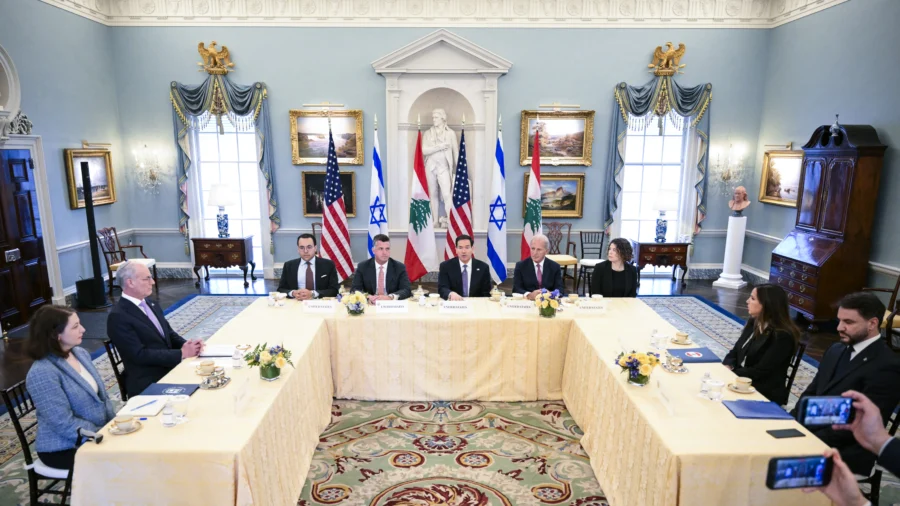
The United States will again host a set of talks between Israeli and Lebanese delegations on May 14 and 15, for what is intended to be an intense effort to advance a lasting peace agreement between the two nations amid recent fighting.
“These talks aim to break decisively from the failed approach of the past two decades, which allowed terrorist groups to entrench and enrich themselves, undermine the authority of the Lebanese state, and endanger Israel’s northern border,” U.S. State Department spokesman Tommy Pigott said on May 8.
While the Israeli and Lebanese governments are not formally engaged in hostilities, Israeli forces have engaged for years in cross-border fighting with Hezbollah, a designated terrorist group that holds influence with Lebanon’s Shia Muslim population and has aligned with Iran.
Pigott said a comprehensive peace deal necessitates fully restoring the authority of the Lebanese government and completely disarming Hezbollah.
Hezbollah ramped up attacks on Israeli territory in October 2023, setting off wider cross-border fighting.
Israeli ground forces entered southern Lebanon in October 2024 and have maintained a presence there ever since. Israeli forces have also conducted extensive airstrikes throughout Lebanon, including in the capital of Beirut.
After U.S. and Israeli forces commenced attacks on Iran on Feb. 28, Hezbollah again ramped up attacks targeting Israel. Clashes continued within Lebanon even after Washington and Tehran reached a ceasefire agreement on April 7.
Despite the ceasefire, military operations have continued in Lebanon. Since April 16, the Israeli military has announced multiple instances in which its ground forces have fired on individuals who were active near their forward positions.
As of May 7, Lebanon’s Ministry of Public Health reported more than 2,700 people have been killed and more than 8,400 have been injured amid Israeli military operations in Lebanon since March 2. The ministry did not delineate between combatants and noncombatants in its tally, and The Epoch Times could not independently verify the figures.
Lebanon’s Ministry of Agriculture also reported that more than 56,000 hectares of Lebanese agricultural land have been affected by recent fighting, threatening food security in the country.
“Discussions will build a framework for lasting peace and security arrangements, the full restoration of Lebanese sovereignty throughout its territory, the delineation of borders, and creating concrete pathways for humanitarian relief and reconstruction in Lebanon,” Pigott said.