

Washington pledged to steadfastly backup Vilnius as it withstands Beijing's intimidation as part of its punitive campaign towards Lithuania.
“China is pushing European and American companies to stop building products with components made in Lithuania or risk losing access to the Chinese market, all because Lithuania chose to expand their cooperation with Taiwan.”
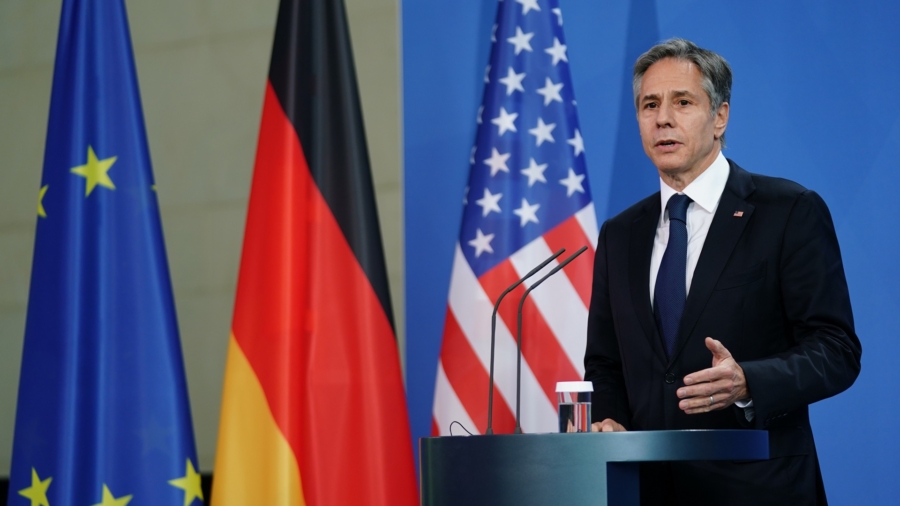
The economic coercion tactics pose “a significant challenge” to shared values of democratic alliances and the international rule of law, said Blinken, calling for transatlantic coordination with Germany to strengthen economic resilience and diverse sourcing supplies.
“Fundamentally, this is about what we’re for together, not what we’re against,” Blinken said.
Baerbock said the country “as Europeans stand in solidarity at Lithuania’s side” and would ban forced labor products from entering its market.
The EU's top trade official said last month that the bloc would stand up to coercive measures imposed on its member state Lithuania. Valdis Dombrovskis, a European Commission vice president from Latvia, said if necessary the E.U. would take up the issue at the World Trade Organization.
The Export-Import Bank of the United States signed a $600 million export credit agreement with Lithuania in November last year, in a bid to resist increased pressure from the Chinese regime.
Taiwan also said on Jan. 6 to set up a $200 million fund to invest in Lithuanian industries and boost bilateral trade, said Eric Huang, the head of the Taiwanese representative office in Lithuania.
Taiwan has redirected 120 shipping containers from Lithuania blocked by China into its market and will take “as much as possible” more, Huang said.
China recalled its ambassador in Vilnius in August, before expelling Lithuania’s envoy in Beijing in November.