


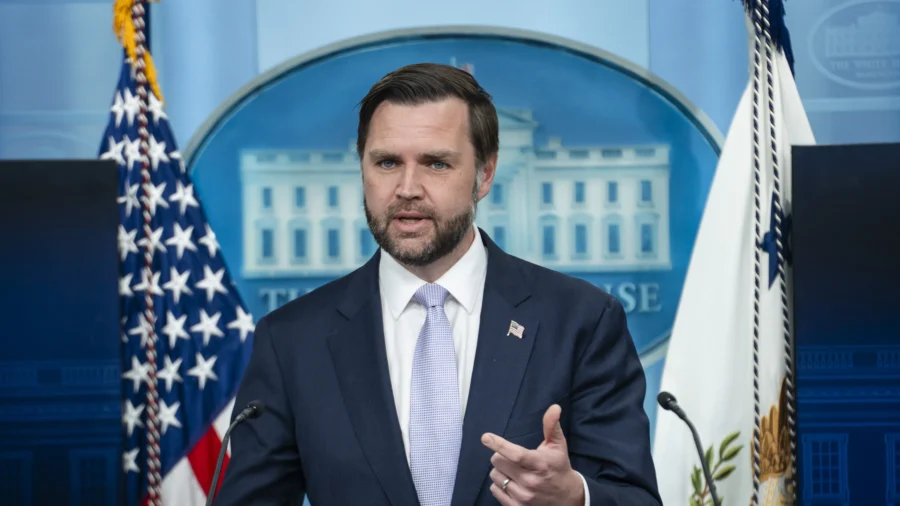
Vice President JD Vance on Tuesday said that Iran’s leadership is “fractured” and their negotiating position with the United States isn’t clear, after President Donald Trump said that he would push back pre-planned strikes against the country the day before.
“The Iranians aren’t themselves quite clear in what direction they want to go,” Vance told reporters at the White House as he filled in for press secretary Karoline Leavitt, who is on maternity leave. “They are also a fractured country,” he added.
Vance added that there are officials who are under the position of Iran’s top leader, Mojtaba Khamenei, who have “some influence in negotiation” but that it’s “not sometimes totally clear what the negotiating position of the team is.” It’s also unclear whether the divisions within the regime are due to poor communication or are done in “bad faith,” he said.
“But I will say with confidence, it’s sometimes hard to figure out exactly what it is that the Iranians want to accomplish out of the negotiation,” he said. “So what we’ve done is try to be as clear as possible.”
The United States is in a “good place” in terms of negotiations, he said, adding that the military is “locked and loaded” if a military campaign against the Iranian regime resumes. A ceasefire between the United States and Iran that was announced in mid-April has mostly held up, although Gulf countries have reported drone attacks in recent days.
Vance also reiterated that the Iranian regime cannot be allowed to develop a nuclear weapon, saying it would cause instability in the Middle East and potentially spark a worldwide nuclear conflict.
“Iran would really be the first domino in what would set off a nuclear arms race all over the world,” he said, adding that the world would be “much less safe” as a result.
Trump has said Iran cannot be able to obtain a nuclear weapon and has suggested in public remarks that Tehran, as part of a deal with the Washington, should hand over its enriched uranium. Iran has long claimed its nuclear program is for peaceful purposes, although the United States, Israel, and some European nations have said the country is enriching uranium to weapons-grade potential.
Iran has been found to have enriched its uranium to 60 percent purity, far exceeding the 3–5 percent needed for civilian nuclear power. Further enriching uranium from 60 percent to the 90 percent needed for weapons-grade material can be done in a matter of weeks.
Negotiations will not involve Russia taking Iran’s enriched uranium stockpile, Vance also said, disputing reports that said otherwise.
Russia’s involvement “is not currently the plan of the United States government,” Vance said. “The Iranians have not raised it. My sense is that’s not something the Iranians would be particularly excited about, and I know the president isn’t particularly excited about it either.”
The comments from the vice president come a day after Trump said he is holding off on a pre-scheduled military strike on Iran planned for Tuesday because “serious negotiations” are underway to end the conflict.
“There seems to be a very good chance that they can work something out,” Trump said at the White House on Monday evening, after first making the announcement in a social media post. “If we can do that without bombing the hell out of them, I’d be very happy.”
Iran has effectively closed the Strait of Hormuz, a vital waterway for the shipment of oil, gas, fertilizer, and other petroleum products. The U.S. is blockading Iranian ports and has redirected 85 commercial vessels from mid-April through Monday, U.S. Central Command said in a social media post.