


Victoria MacKenzie-Childs, ceramic artist and co-founder of the MacKenzie-Childs home decor brand, died on March 4, her family said. She was 77 years old.
“I already miss you so much, but am so grateful for the impressions you left on me on how to design life with unlimited freedom; without limits or boundaries!” he said.
“When Victoria knew something was right within her heart, she went forward and didn’t care numbers of opposing opinions…that is leadership with moral fiber, and that was and still is Victoria MacKenzie-Childs,” he wrote. “And I would love to give my huge gratitude and big love to Veronica for being the best friend to Victoria that anyone could ever wish for!”
She and her husband, Richard, co-founded MacKenzie-Childs in Aurora, New York, in 1983.
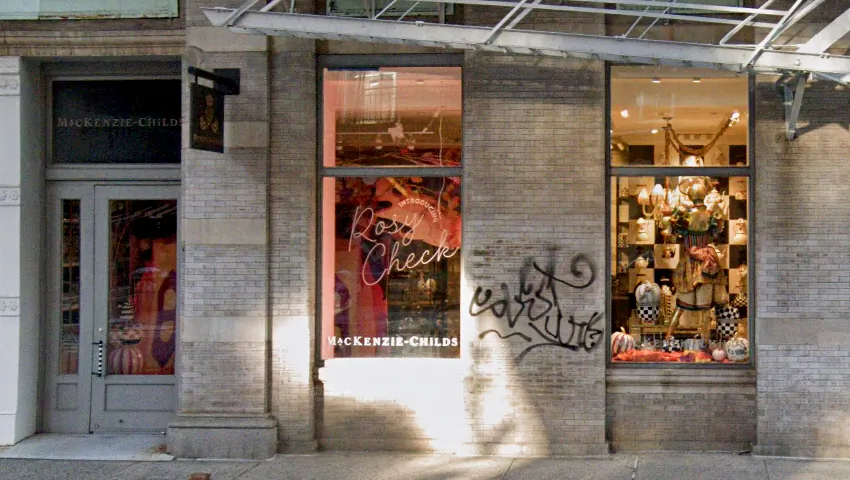
She became known for her whimsical, hand-painted ceramics and bold home accessories. The brand’s distinctive furniture and home goods featured the signature black-and-white “Courtly Check” pattern, inspired by chessboards and tilework.
The brand gained national recognition in the 1990s, when MacKenzie-Childs products appeared in upscale retailers including Bergdorf Goodman and Neiman Marcus.
“But when you see the MacKenzie-Childs department, you know it’s MacKenzie-Childs,” he said.
Production in Aurora also supported the local economy. According to Life in the Finger Lakes, dozens of artisans worked on-site to create pottery and furniture. Feldman told the magazine that people value the hard work that goes into the products.
“It’s handmade with terracotta clay on a beautiful farm in Aurora. It’s hand-painted. It might have had 12 different people work on it. It could have been fired four times. It may have taken several weeks to produce,” he said.
Today, MacKenzie-Childs products are made both in Aurora and at international locations.
MacKenzie-Childs was born in San Francisco in 1948. She earned a Bachelor of Fine Arts from Indiana University and a Master of Fine Arts from the New York State College of Ceramics at Alfred University, where she studied alongside her husband, Richard.
Before launching the company, she worked as a freelance clothing and costume designer and studied pottery under ceramic artist Wayne Higby at Alfred.
The company, MacKenzie-Childs, grew rapidly but faced financial difficulties in the early 2000s and filed for bankruptcy. In 2001, the brand was sold in a court-approved bankruptcy sale, and the founders lost control of the company.
Victoria and Richard MacKenzie-Childs later founded Victoria and Richard Emprise, producing home furnishings and jewelry.
In 2003, they purchased the historic Yankee Ferry, a former Ellis Island ferryboat, converting it into a floating home and studio.
She is survived by her husband and daughter, Heather Chaplet, a textile designer.