

On Friday’s War Room with Steve Bannon, Sen. Jim Banks (R-Ind.) was asked if China was “at the point of a hard decoupling from the American financial system.”
“For sure,” he said, adding that putting economic and financial pressure on China was a negotiation tactic. “That’s the lever of strength the United States can use to bring stability to our trade relations with China,” he said on the show last week.
Banks was on the podcast to discuss an amendment he has proposed to the National Defense Authorization Act (NDAA) that would ban the sale of advanced computing chips to China if there is demand for those chips in the United States. But if Wall Street is any example, the big semiconductor manufacturers could get that amendment stripped out of the NDAA. Financial institutions in 2024 had succeeded in removing language that would have banned federal employees from investing in mutual funds holding Chinese stocks and bonds.
The TSP manages more than $700 billion on behalf of federal employees, including approximately 6 million civilian and military participants.
Last year, as the Federal Retirement Thrift Investment Board considered removing China from the stock index that the I-Fund tracks, Congress included an amendment by then-Sen. Marco Rubio (R-Fla.) in the 2024 NDAA to ban all mutual funds with China-based holdings from being offered by TSP. That amendment was never considered.
No Action on Wall Street Flows
This year, there have yet to be any bills or executive orders aimed at curtailing Wall Street investments in China.In January, the Biden administration added 37 companies to the Uyghur Forced Labor Prevention Act (UFLPA) Entity List. Some of those companies trade on the Shanghai Stock Exchange. One example is Hoshine Silicon Industry, a supplier to solar and semiconductor manufacturers, which counts Vanguard and BlackRock as investors through international portfolios held by U.S. retail investors.
Despite high-profile divestments by some on Wall Street, like Ray Dalio’s exit from Bridgewater Associates and their subsequent selling of China stocks, others continue to send their money into China.
Top Five China ETFs in the US
There are 24 pure China equity ETFs listed in the United States as of mid-2025, according to the ETF Database. The biggest is the KraneShares China Internet ETF, followed by two BlackRock ETFs, the iShares MSCI China, and the iShares China Large Cap fund. Deutsche Bank’s ETF, the XTrackers, invests only in China stocks listed in Shanghai and Shenzhen, and Invesco is the KraneShares’ China tech rival.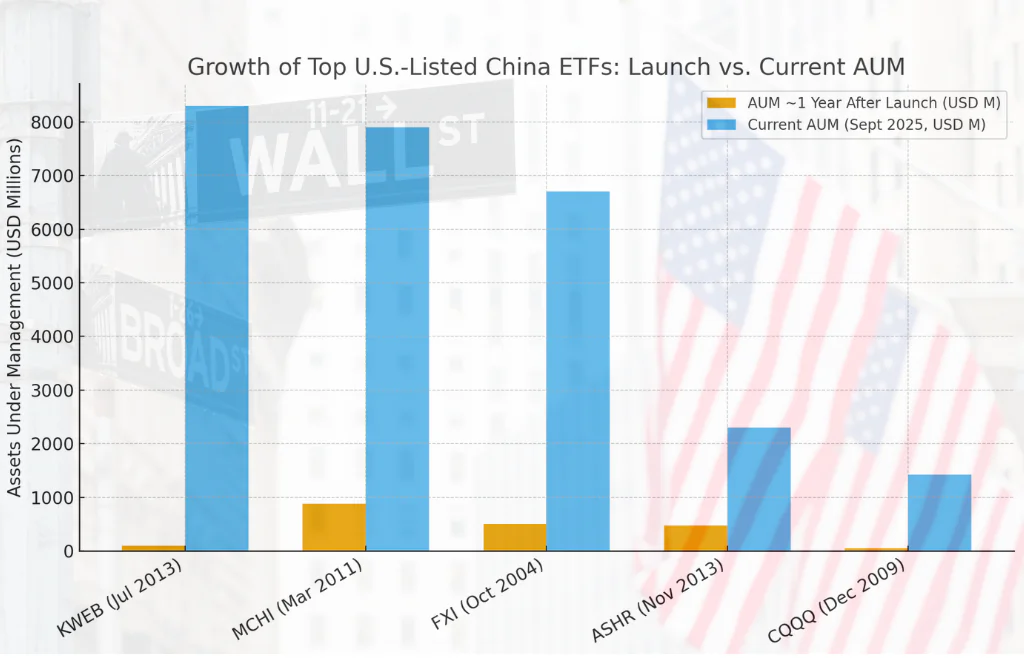
Congressional Paralysis?
There currently exist a few restrictions on publicly traded Chinese military companies and human rights violators accessing U.S. capital, said Justin Bernier, CEO of the National Security Index, an ETF company listed on Nasdaq.“But overall, Congressional leaders have killed every piece of legislation meant to cut off the money. Treasury hasn’t added a Chinese stock to its sanctions list since the first Trump administration.
“This inaction is a testament to Wall Street’s raw power in Washington,” Bernier Told NTD.
The report highlighted how American investors are giving Beijing the financial muscle to compete in the new space race.
For example, China’s Aerospace Corporation has a large family tree of unsanctioned defense-related companies that continue to receive money from American investors. One of them is China Aerospace International Holdings Limited (CASIL), a company involved in the Chinese military’s ballistic missile program, the Prague Securities study said.
“Maximizing investor return is not the motivation for large emerging-markets funds holding slave-labor companies and foreign defense firms that rival the U.S. military,” Bernier said. “The real interest is having access to mainland China’s expanding wealth management market.
“Wall Street firms such as BlackRock and Goldman Sachs have created joint ventures with China’s state-owned banks to sell annuities and mutual funds to hundreds of millions of new clients. Wall Street gets billions in fees, and Chinese stocks get capital inflows,” he said.
“BlackRock and Goldman are not going to voluntarily divest from bad-actor companies and risk their relationships with the ruling party in Beijing. There’s too much money at stake.”