


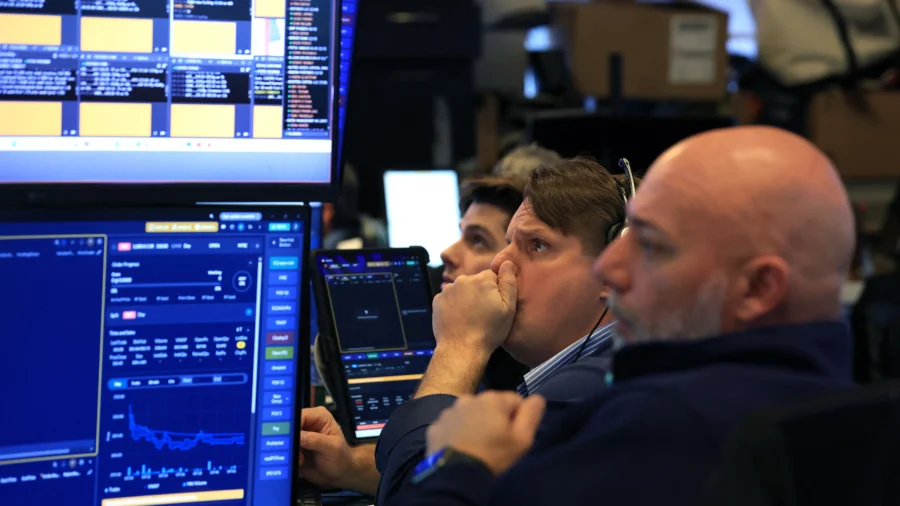
Wall Street’s multi-week rally shifted into higher gear this week, driven by strong earnings from Alphabet, Qualcomm, Amazon, and Apple. The S&P 500 and Nasdaq hit fresh record highs, with the Nasdaq closing above 25,000 for the first time—a bullish technical milestone for the index.
The rally held despite rising oil prices, a fragile Middle East peace, and higher bond yields following a divided Federal Open Market Committee (FOMC) meeting.
For the week, the Dow Jones Industrial Average gained 0.55 percent to close at 49,499. The S&P 500 rose 0.91 percent to 7,230, hovering near record territory. The Nasdaq Composite led gains for a fourth straight week, surging 1.12 percent to another all-time high, while the Russell 2000 added 0.93 percent.
Market volatility dropped sharply, with the CBOE Volatility Index ending at 16.99, down by 9.19 percent for the week.
Stocks traded mixed on April 27 as investors showed hesitation ahead of a busy week that included major earnings reports and the FOMC meeting. Renewed uncertainty over Middle East peace talks also weighed on sentiment. The Nasdaq and S&P 500 edged up by 0.2 and 0.1 percent, respectively, while the Dow slipped by 0.1 percent. Despite the mixed close, the Nasdaq hit a fresh intraday record, led by Nvidia, which reached a new high on optimism over AI chip demand.
“This may be the most important week for markets so far this year, with big tech earnings and a key Federal Reserve meeting coming at a time when markets are trying to figure out their next step now that it seems like the Iran conflict is contained,” Glen Smith, chief investment officer of Flower Mound, Texas-based GDS Wealth Management, told The Epoch Times.
Smith said earnings are back in the driver’s seat and big tech results would be critical for setting the market’s direction after its recent rapid run-up.
“Big tech stocks are priced for perfection heading into earnings this week, which puts plenty of pressure on these companies to report blowout earnings,” he said.
“Earnings for big tech stocks are likely to come in higher than expectations largely because these companies are still printing money, and expectations have been lowered given the tone of the market. While positive, it is fragile given the conflict in the Middle East.”
Equity markets turned lower on April 28 amid soaring oil prices and renewed concerns over AI companies’ ability to monetize their business models, ahead of earnings reports from several Magnificent 7 companies.
“In a stock market where earnings expectations are rising even faster than stock prices, any misstep involving AI-related demand or capital budget expenditures from one of the four Mag 7 companies reporting Wednesday could easily give this market second thoughts about how far it has run in the past month,” Dennis Follmer, chief investment officer of Waltham, Massachusetts-based Montis Financial, told The Epoch Times.
Tech stocks and small caps led the decline, with the Nasdaq and Russell 2000 falling by 0.90 percent and 1.13 percent, respectively. The S&P 500 and Dow fared better, supported by a rally in Coca-Cola shares on strong earnings and gains in the healthcare sector, including UnitedHealth.
The broad market sell-off came despite a better-than-expected consumer confidence reading. The Conference Board Consumer Confidence Index rose by 0.6 points to 92.8 in April, topping market expectations of 88.9.
The Present Situation Index dipped marginally to 123.8, while the Expectations Index climbed to 72.2. Concerns about rising gasoline prices linked to Middle East tensions were partially offset by modest improvements in labor market and income expectations.
Markets turned choppy on April 29 as oil prices surged to multi-year highs, dimming hopes for a swift end to the conflict in the Middle East. West Texas Intermediate crude futures jumped by 7 percent to above $107 per barrel, reviving inflation fears and pushing the 10-year Treasury yield toward 4.42 percent, a one-month high.
Adding to the pressure, the FOMC voted to hold the federal funds rate steady. Although widely expected, the decision was not unanimous, highlighting uncertainty over the rate outlook. Short-term Treasury yields rose sharply, with the 2-year yield climbing above 3.95 percent.
“The Fed didn’t cut rates, but there were plenty of fireworks at this meeting. Four Fed officials dissented, the most since 1992. Three of those officials wanted to signal that the Fed’s next move may be a rate hike. The fourth wanted to cut rates,” Heather Long, chief economist of Navy Federal Credit Union, told The Epoch Times.
Long said the war in Iran has complicated the Federal Reserve’s decision-making, with a wide range of views on what steps the central bank should take next.
“For now, the Fed is on hold, but good luck to new Fed Chair Kevin Warsh trying to get agreement going forward,” he said.
Equity investors appeared equally divided. Major averages finished the day mixed, with the Dow and Russell 2000 down by 0.57 percent and 0.60 percent, respectively. The Nasdaq and S&P 500 ended nearly unchanged, ahead of after-hours earnings reports from several major tech companies.
Markets roared back on April 30, led by the Dow and Russell 2000, which gained 1.62 percent and 2.20 percent, respectively. The S&P 500 and Nasdaq rose by 1.02 percent and 0.89 percent, respectively, to new records.
The catalyst was strong earnings from Alphabet and Qualcomm, whose shares surged by 9.97 percent and 15.12 percent, respectively, after both companies topped revenue and earnings expectations. An in-line inflation report and a softer GDP reading also supported sentiment.
The Personal Consumption Expenditures index rose at an annual rate of 3.5 percent in March, matching expectations.
GDP expanded at an annualized rate of 2 percent in the first quarter, up from 0.5 percent in the previous quarter but slightly below the 2.3 percent consensus estimate.
“Markets have recovered nicely from the first-quarter lows as earnings take over the narrative,” an eToro U.S. investment analyst told The Epoch Times.
“But the question is whether that narrative can hold up if energy prices remain at these elevated levels.”
Meanwhile, he said, investors will be watching how the Federal Reserve navigates the situation, with expectations of a more dovish chair leading a committee that appears increasingly divided.
“As we enter the midpoint of the year, market fundamentals and Fed policy will be two key forces investors need to watch,” he said.
The S&P 500 and Nasdaq added another 0.29 percent and 0.89 percent on May 1, hitting fresh records. The Russell 2000 gained 0.46 percent, while the Dow slipped by 0.31 percent.
The Nasdaq’s advance was powered by Apple’s strong earnings report, released after the previous day’s market close, which highlighted robust demand for Mac Minis and pushed its shares up by 3.24 percent. Software stocks were also strong, with Atlassian surging by 29.58 percent and Salesforce.com gaining 4.13 percent.