


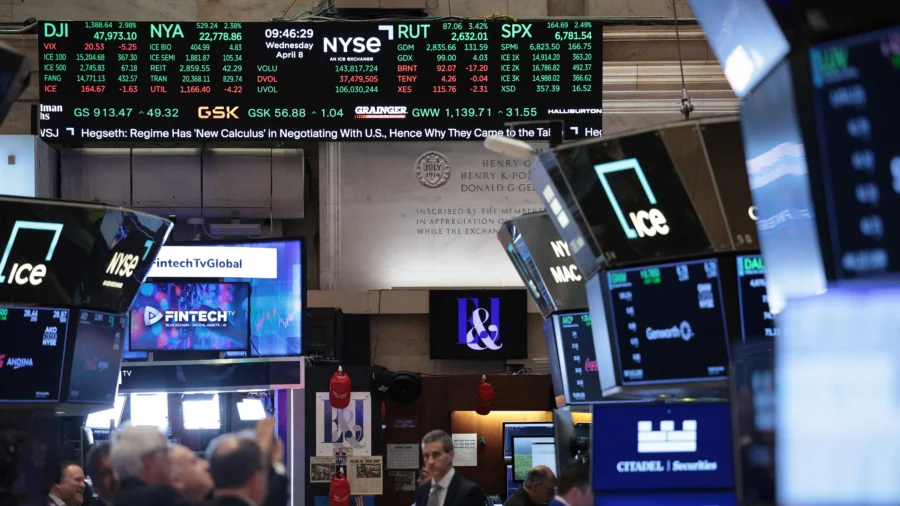
Stocks extended their rebound into the second week of April, supported by a temporary truce in the Middle East that eased pressure on oil prices and improved investor sentiment.
The advance came despite fresh economic data pointing to rising inflation and slower growth, suggesting that investors view near-term risks as having passed and expect both inflation and growth to stabilize.
Healthcare, tech, and leisure stocks led the market gains.
For the week, the Dow Jones Industrial Average rose by 3.04 percent to 47,916, ending slightly below its weekly high. The S&P 500 gained by 3.56 percent to 6,816, also near its weekly high. The Nasdaq Composite led for a second consecutive week, climbing by 4.68 percent, while the Russell 2000 advanced by 3.97 percent.
Market volatility increased early in the week but declined sharply toward the end. The Chicago Board Options Exchange Volatility Index closed at 19.23, down by 20.44 percent for the week.
Stocks began trading on April 6 in mixed fashion, reflecting a tug-of-war between bullish and bearish sentiment following a stronger-than-expected labor market report released on April 3.
March payrolls rose by 178,000 jobs, well above expectations and marking the largest increase since December 2024. At the same time, the unemployment rate edged down to 4.3 percent, while labor force participation slipped to 61.9 percent.
ZipRecruiter economist Nicole Bachaud expressed cautious optimism about the labor market but pointed to underlying structural challenges.
“Changing immigration trends are leading to lower labor force participation, as the native-born population continues to see a falling participation rate. Fewer workers are waiting out long unemployment stints, leading to more discouraged and marginally attached workers,” she told The Epoch Times.
She said that increased job opportunities could encourage these workers to return to the labor market, but it might not be sufficient to offset the effects of shrinking immigration and an aging workforce.
“A tight labor market could be on the horizon as this year progresses, meaning many employers might want to plan now for how to remain competitive as job growth increases.”
The labor report presented a mixed outlook for markets. Strong job growth could support incomes and consumer spending, a key driver of the U.S. economy, while tighter labor conditions could lead to higher wages and inflation, putting upward pressure on interest rates.
Reflecting these concerns, the U.S. 10-year Treasury yield hovered around 4.33 percent early in the week, near its highest level in several days.
At the same time, oil prices remained elevated amid uncertainty surrounding the Middle East conflict.
By late morning, equities moved higher as both bond yields and oil prices stabilized, with all major indexes closing in positive territory. The Nasdaq and S&P 500 led gains, rising by 0.54 percent and 0.42 percent, respectively, while the Russell 2000 and the Dow added 0.42 percent and 0.36 percent.
Markets remained volatile on April 7, as investor sentiment shifted with developments in the Middle East. Early losses tied to fears of escalating conflict gave way to partial recovery in the afternoon on hopes that a broader war could be avoided. By the market close, the Nasdaq, S&P 500, and Russell 2000 posted modest gains, while the Dow ended slightly lower.
Health care stocks helped support the market, following news of a larger-than-expected increase in Medicare payments. UnitedHealth Group rose by 9.37 percent, CVS Health gained by 6.74 percent, and Humana climbed by 7.94 percent.
The rebound accelerated on April 8 after reports of a temporary ceasefire and the reopening of the Strait of Hormuz, which pushed oil prices and bond yields lower.
“Wall Street is exhaling as President Trump pressed pause on the destruction button, as there are enough signs that there's a will to negotiate a deal, and that optimism is helping to end this stock market correction,” Robert Edwards, chief investment officer at Edwards Asset Management, told The Epoch Times.
Travel and leisure stocks and semiconductor shares led gains on expectations that lower energy prices could help the economy avoid stagflation. The Amplify Travel ETF rose by 5 percent, while the ProShares Ultra Semiconductors ETF climbed by 8.53 percent.
“The Federal Reserve might cut interest rates in December, but don’t expect them to act before then unless there is a massive hit to the U.S. economy. The March minutes show how tough this moment is for the Fed,” Heather Long, chief economist at Navy Federal Credit Union, told The Epoch Times.
Despite tempered expectations for near-term rate cuts, equities maintained strong gains. The Russell 2000 and the Dow rose by 2.97 percent and 2.85 percent, respectively, while the Nasdaq and S&P 500 advanced by 2.80 percent and 2.51 percent, respectively.
Stocks paused on April 9 following mixed economic data. The Federal Reserve’s preferred inflation gauge, the Personal Consumption Expenditures (PCE) price index, rose 2.8 percent year-over-year in February, unchanged from the previous month and in line with expectations.
“Headline PCE remains sticky as well, holding in the 2.8 percent range, while goods inflation continues to act as a headwind—something the Fed has recently linked to tariffs,” Bret Kenwell, U.S. investment analyst at eToro, told The Epoch Times.
Meanwhile, U.S. economic growth was revised lower, with GDP expanding at an annual rate of 0.5 percent in the fourth quarter of 2025, down from earlier estimates.
“While it was a noisy quarter due to a record-long government shutdown, it’s still not an especially reassuring data point given the current backdrop,” Kenwell said.
The market’s pullback proved short-lived, as buyers returned and pushed major indexes higher by the market close. Technology stocks led gains, with the Nasdaq rising by 0.83 percent, while the S&P 500, Dow, and Russell 2000 each gained by about 0.60 percent.
Another inflation report shaped trading on April 10. Consumer prices rose by 3.3 percent year over year in March, up from 2.4 percent in the previous two months, marking the highest level since May 2024, driven largely by higher energy costs.
Markets ended the week on a mixed note, as investors appeared to expect that both inflation and growth pressures could ease if geopolitical tensions subside. The Dow, S&P 500, and Russell 2000 closed lower for the day, while the Nasdaq posted gains.
Technology stocks were supported in part by strong corporate results. Taiwan Semiconductor Manufacturing Company reported a 45.2 percent increase in March revenue, helping lift sector sentiment.
Looking ahead, Kenwell said investors will be closely watching labor market stability and corporate earnings.
“If management teams tell a constructive story about resilient consumers and steady demand, investors may breathe a sigh of relief and refocus on the fundamentals. That is, of course, assuming we avoid a major setback on the geopolitical front,” he added.