


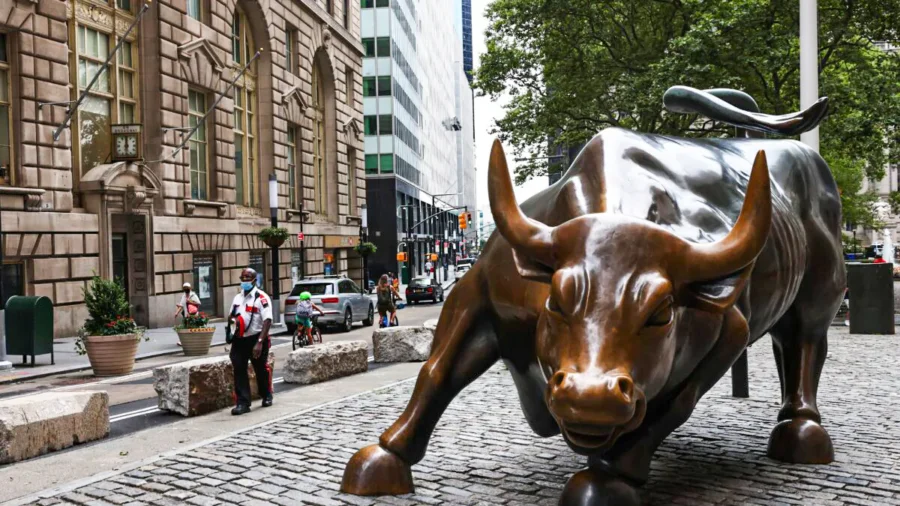
Wall Street opened sharply lower on April 13, with investor sentiment hit by the failure of U.S.–Iran peace talks and a renewed surge in oil prices, which climbed back above $100 a barrel amid escalating tensions in the Persian Gulf.
As of 9:40 a.m. ET on April 13, the Dow Jones Industrial Average had fallen by 0.72 percent. The S&P 500 fell by 0.33 percent, while the Nasdaq Composite fell by 0.36 percent.
Brent crude rose by 5.79 percent to $100.7 a barrel, after earlier climbing above $101, while U.S. West Texas Intermediate gained 5.48 percent to $101.9, having briefly topped $103, according to OilPrice.com.
Analysts said markets had shifted back into a “risk-off” posture as geopolitical uncertainty deepened.
"We expect renewed pressure on risk assets and upward moves in oil early this week," said Benjamin Jones, global head of research at Invesco.
"There has been a de-escalation in the armed conflict but the scale of the de-escalation and lack of clarity on when trade flows will resume leaves us broadly still in the same place—status quo—from an economic perspective."
Others suggested the market reaction, while negative, was relatively contained given the scale of the geopolitical risk.
“I was expecting much worse both for the equity market and oil prices this morning,” Mary-Sol Michel, director of discretionary portfolio management at Swiss Life Banque Privée, told Bloomberg on Monday.
“The market sees the blockade as a negotiation tool, but nonetheless, I feel the impact on stocks is quite modest.”
Trump said on April 12 that U.S. forces would “seek and interdict every vessel in International Waters that has paid a toll to Iran” and would prevent ships from entering or leaving the Strait of Hormuz.
“No one who pays an illegal toll will have safe passage on the high seas,” Trump added.
Analysts said the economic implications for Iran, and potentially for global energy markets, could be significant.
Rabobank analysts said in an April 13 note that oil prices were “sure to jump” as markets priced in the potential loss of Iranian export volumes and the risk of renewed conflict.
"The U.S. blockade isn’t aimed at stopping GCC energy and goods flowing, which they aren’t anyway, but will stop Iran exporting energy, or importing food, industrial parts, or weaponry by sea," wrote RaboResearch’s Global Strategist Michael Every.
The Gulf Cooperation Council (GCC) is a bloc of six major oil-producing states including Saudi Arabia and the United Arab Emirates.
"The economic impact will be enormous, and in around 13 days, Iranian oil storage will be full, forcing well shut-ins and risking permanent supply-side damage," he said.
Malecki said more than 90 percent of Iran’s $109.7 billion in annual trade transits the Persian Gulf, with oil and gas accounting for 80 percent of export earnings and 23.7 percent of GDP, adding that Kharg Island generates around $53 billion a year in net oil export revenue.